
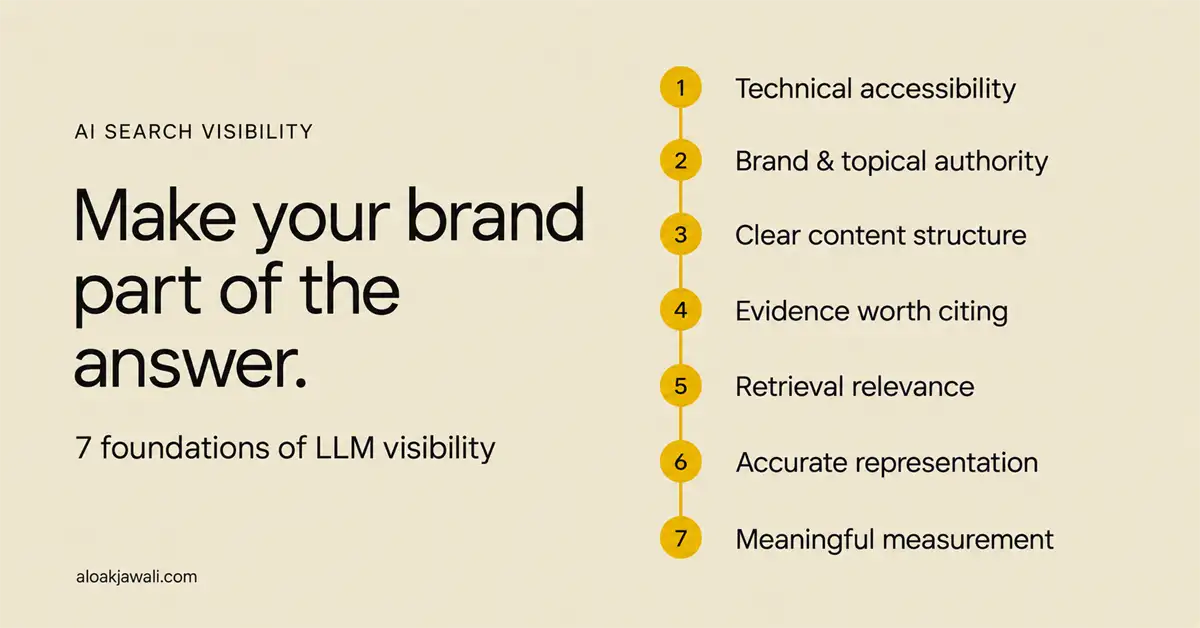
Improving brand visibility in LLMs starts with making your business easy to discover, understand, and describe accurately. Your website needs accessible information, clear explanations, and credible evidence that helps people make decisions.
Large language models, or LLMs, power many conversational AI experiences. Customers use these experiences to research products, compare providers, and ask follow-up questions before buying.
For a business owner, this creates an important question:
When someone asks an AI system about your industry, does your brand appear—and is it represented correctly?
Answering that question requires more than checking whether your company name appears once. You need to understand which questions matter, which sources influence the answers, and whether that visibility contributes to business results.
This guide explains a seven-part framework covering technical accessibility, authority, content structure, evidence, retrieval, brand representation, and measurement.
What Does Brand Visibility in LLMs Mean?
Brand visibility in LLMs describes how often, where, and in what context a brand appears in AI-generated responses.
That appearance can take several forms:
- A mention of your company or product.
- A description of your services.
- Inclusion in a comparison.
- A citation linking to your website.
- A reference to a third-party source discussing your business.
These are different outcomes. An AI answer may mention your brand without linking to you. It may cite your research without recommending your product.
Accuracy matters as much as presence. A response that gives the wrong service area, outdated pricing, or an unsupported product claim can create confusion.
The goal is useful visibility: appearing in relevant conversations with information that helps customers evaluate your business.
How Do AI Systems Find Information About Brands?
An LLM and the search tools connected to it are not the same thing.
Depending on the system and mode, a response may draw on information learned during training, information supplied in the conversation, or material retrieved from external sources.
Retrieval-augmented generation, often called RAG, allows a system to use retrieved information when producing an answer. Microsoft explanation of retrieval-augmented generation
This distinction matters because publishing a page does not immediately update every model’s learned knowledge. An accessible page may become available to a retrieval system without changing the underlying model.
Your practical focus should be the information you can improve: your website, product documentation, public business profiles, and credible external coverage.
1. Technical Accessibility: Make Important Content Discoverable
Before information can help customers through search, relevant systems need to be able to access it.
Start with your most important pages: products, services, pricing, locations, company information, and supporting resources.
Check whether those pages load correctly, can be discovered through links, and expose their important information as readable content.
Common problems include accidental indexing restrictions, broken links, inaccessible pages, and essential details available only inside images.
Rendering also matters. A page that looks complete in your browser may depend on interactions that some retrieval systems do not perform.
For Google’s generative search features, its current guidance includes indexing and snippet eligibility, along with inclusion in Search generative AI features. Meeting these requirements does not guarantee appearance. Google technical guidance
Access rules differ across platforms. Check the relevant provider’s documentation before changing crawler permissions, and distinguish search access from model-training permissions.
Practical example: If a software company’s integration details are available only after login, publish an accurate public overview that helps prospective buyers understand compatibility.
2. Entity and Topical Authority: Explain Who You Are and What You Know
An entity is an identifiable person, business, product, place, or other subject.
For your brand, entity clarity means making the relationships between your company, products, people, and areas of expertise easy to understand.
Your website should clearly explain:
- What your business does.
- Who your products or services help.
- Which markets or locations you serve.
- Who creates or reviews your content.
- What evidence supports your experience.
Use consistent names and accurate descriptions across your website and public profiles.
Topical authority is a useful way to describe demonstrated expertise across a subject. It is not a universal score shared by all AI platforms.
A business demonstrates expertise by addressing related customer needs with substance. A cybersecurity provider, for example, could publish practical explanations of implementation, incident response, service scope, and purchasing considerations.
The objective is to create a coherent, credible picture of the business. Repeating a category keyword across dozens of thin pages does little to help a buyer evaluate it.
3. Information Architecture: Make Answers Easy to Find
Information architecture is how your website organizes and connects its content.
A clear structure helps visitors move from a broad question to a useful answer and then to a relevant product or service.
For example, a visitor researching customer support software might need to understand pricing, integrations, implementation time, and reporting capabilities.
Those subjects should be easy to locate through descriptive navigation and internal links.
Within each page, use headings that explain what the section covers. Answer the main question directly, then add examples, qualifications, and evidence.
Choose the format that suits the decision:
| Customer need | Useful content format |
| Understand a term | Clear definition with an example |
| Compare options | Table with meaningful criteria |
| Complete a task | Ordered instructions |
| Evaluate suitability | Use cases, requirements, and limitations |
| Resolve a concern | Specific question and answer |
Keep important explanations in visible page text. An infographic can support the message, but it should not be the only place the information appears.
For background on how these practices connect, explore our guide to SEO, AEO, and GEO.
4. Citation-Worthiness: Publish Information Worth Referencing
A page is more useful when it contributes evidence or insight beyond a generic summary.
That contribution might be original research, a documented experiment, an expert explanation, a detailed comparison, or a practical resource.
A small business does not need a large research department to create something valuable.
A commercial supplier could publish a compatibility guide based on verified specifications. A service business could explain recurring customer problems using documented experience. A software company could publish a transparent implementation study.
If you publish statistics, explain where they came from. Original research should identify the sample, collection period, method, and limitations.
Expert opinions also need context. Explain who the expert is, what experience informs the opinion, and whether the statement is an observation or an established fact.
Microsoft’s Bing guidance recommends supporting content with examples, data, and sources, while keeping information clear and current. These practices can improve usefulness without guaranteeing a citation. Bing guidance on AI visibility
5. Retrieval Optimization: Address the Information Customers Need
Retrieval optimization means improving the relevance and accessibility of information that a system might retrieve to answer a question.
For a business, the starting point is understanding the conversations where it would reasonably belong.
Consider these illustrative questions for a B2B software brand:
- Which tools help a small support team manage customer inquiries?
- What should we compare before choosing a help desk?
- Which solutions support the integrations we need?
- What affects implementation time?
- When would this product be a poor fit?
Each question reflects a different decision.
Map those needs to your existing content. Identify where the answer is missing, incomplete, or difficult to find.
One strong page may address several related questions. You do not need a separate page for every wording variation.
Google explains that its AI features may issue related searches to explore a question. It also advises against creating large quantities of pages primarily to manipulate generative search visibility.
Build content around the underlying information need. A collection of awkwardly repeated prompts is unlikely to help customers.
6. Brand Representation: Check What AI Says About You
Brand representation concerns the accuracy and context of how your business is described.
Create a small, repeatable set of questions to test across relevant experiences, such as ChatGPT, Gemini, Perplexity, and Google’s AI search features.
Include both branded and unbranded questions.
A branded question might ask what your company offers. An unbranded question might ask which providers serve a particular customer need.
For each observation, record the wording, date, platform, mode, relevant location settings, and whether web search was used.
Review the response for:
- Incorrect or outdated facts.
- Confusion with another company.
- Missing products or capabilities.
- Unsupported claims.
- Relevant competitors mentioned.
- Sources cited to support the answer.
Then investigate the underlying information.
If an answer gives an old address, check your website and public listings. If it misstates a product’s capabilities, examine the cited material and your documentation.
Correct the sources you control and request factual corrections where appropriate elsewhere. Updating a source does not guarantee that every AI response will change immediately.
The objective is accurate representation, including truthful limitations.
7. Measurement: Track Visibility and Business Outcomes Together
Traditional rankings remain useful, but they do not fully describe AI answer visibility.
A measurement plan should distinguish mentions, citations, accuracy, traffic, and business results.
| Metric | What to record | What it helps you assess |
| Brand mentions | Responses that name your brand | Presence within the questions tested |
| Citations | Responses that cite your content | Use of your material as a source |
| Linked sources | Exact URLs referenced | Which pages or external sources contribute |
| Share of answer | A clearly defined share within your sample | Presence relative to selected competitors |
| Sentiment and context | Favorable, neutral, unfavorable, or mixed treatment | How the answer frames your brand |
| Factual accuracy | Correct and incorrect claims | Representation problems to investigate |
| Referral traffic | Identifiable visits from AI platforms | Measurable website traffic |
| Business outcomes | Qualified inquiries, purchases, or assisted conversions | Commercial contribution |
Define “Share of Answer” Before Reporting It
There is no single universal definition.
For a competitive comparison, you could define it as your brand’s share of all distinct brand appearances across a fixed set of responses.
Count each brand once per response. State which competitors, prompts, platforms, and dates are included.
Track mention rate separately. For example, if your brand appears in eight of 20 sampled responses, its observed mention rate is 40%. That is a hypothetical sample result, not a claim about total market visibility.
Use Platform Reports Where Available
Google Search Console’s Generative AI performance report provides impressions from supported AI search features, including AI Overviews and AI Mode. It supports analysis by dimensions such as page, country, and device. Google report documentation
Bing Webmaster Tools AI Performance reporting provides citation and cited-page insights across supported Microsoft experiences. Citation counts do not represent a page’s rank or authority. Bing AI Performance documentation
Combine those reports with website analytics and lead data. Some AI-influenced visits will not carry an identifiable referral, so referral traffic alone cannot capture every contribution.
How the Framework Changes by Business Type
The same principles apply across business models, but the priorities differ.
B2C brands should make product details, availability, compatibility, delivery, and returns clear. Buyers often need practical comparisons before purchasing.
Small and medium-sized businesses should begin with essential services, accurate business information, and the questions that repeatedly appear in sales conversations.
B2B companies often need deeper information about implementation, integrations, service scope, procurement, and relevant experience.
Choose topics that help your actual customers make decisions. Broad visibility has limited value if it attracts people your business cannot serve.
A Practical 90-Day Starting Plan
Treat the first 90 days as a period for implementation and learning, not a promised deadline for AI visibility.
Days 1–30: Establish a baseline. Review important pages, check technical access, document brand facts, and select a manageable set of customer questions.
Days 31–60: Improve the highest-priority gaps. Clarify service descriptions, strengthen internal links, correct inconsistent information, and publish useful evidence.
Days 61–90: Repeat the observations using comparable conditions. Review cited sources, representation errors, website engagement, and qualified inquiries.
Keep a record of major changes. An increase in mentions after publishing new content may be encouraging, but it does not prove that the content alone caused the change.
Use the findings to decide what to improve next.
8 Frequently Asked Questions
1. Can a Small Business Improve Its Visibility in LLMs?
Yes, it can improve the information available about its business. Start with clear service pages, accurate public details, and useful answers to specific customer questions. Appearance in any individual AI response remains outside the business’s direct control.
2. Is LLM Visibility the Same as SEO?
They overlap, but the measurements differ. SEO includes discoverability and search performance, while LLM visibility examines how a brand appears in generated answers. Google considers optimization for its generative search experiences part of SEO.
3. Does Ranking First on Google Guarantee an AI Citation?
No. A search ranking and selection as a source in an AI response are different outcomes. The question, retrieved sources, platform, and context can affect what appears.
4. Do I Need a Special File or Schema for Google AI Search?
Google says it does not require special AI files or schema markup for generative search visibility. It also states that Google Search ignores llms.txt. Other systems may have different requirements.
5. Can AI-Generated Content Help?
It can support research organization, drafting, and editing. The finished page still needs accurate information, useful evidence, and editorial judgment. Generating more pages does not automatically make a brand more relevant.
6. How Long Does It Take to See Results?
There is no universal timeline. Discovery, retrieval, source updates, competition, and platform behavior all affect results. Track changes over time rather than relying on a promised number of days.
7. Can I Correct an AI System’s Description of My Brand?
Start by identifying the inaccurate claim and checking any cited sources. Correct your own public information and use available feedback channels. A correction may take time to appear and may not affect every response.
8. What Should I Measure First?
Begin with a fixed set of relevant questions, observed brand mentions, citations, and factual accuracy. Add identifiable referral traffic and qualified business outcomes so visibility can be evaluated alongside its practical value.
Make Your Brand Easier to Discover, Understand, and Reference
A useful way to describe the goal is:
“Build on SEO so your brand can be discovered, retrieved, understood, accurately represented, and cited.”
The work crosses several teams. Marketing explains the offer, product teams provide accurate details, technical teams support access, and subject experts contribute evidence.
Start with the questions your customers need answered. Make those answers easy to find and strong enough to help someone decide.