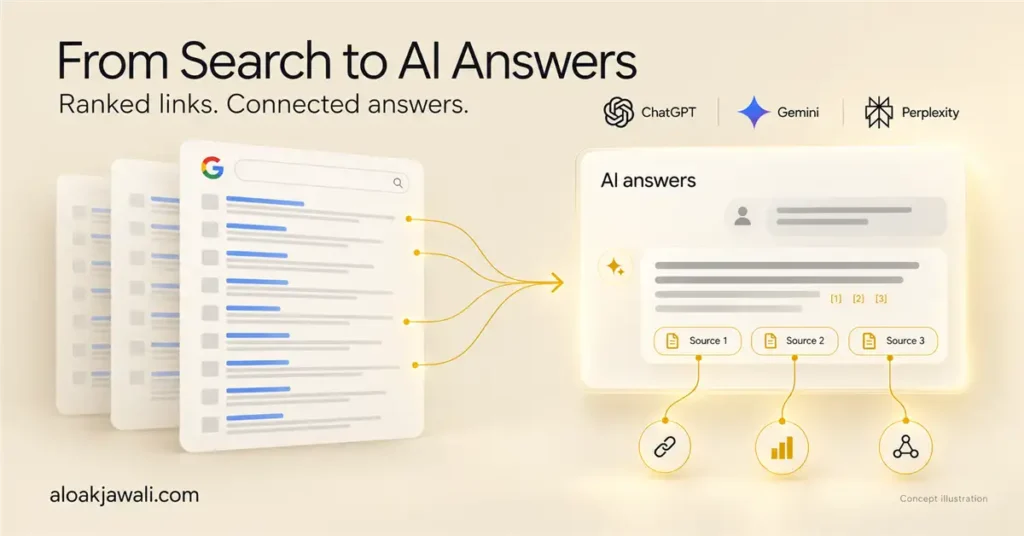
AEO Best Practices are becoming increasingly important for businesses that want their content to be discovered, understood, and referenced by AI-powered search platforms. As people turn to ChatGPT, Google AI Overviews, Perplexity, Gemini, and Microsoft Copilot for recommendations and answers, businesses need to think beyond conventional keyword rankings.
Answer Engine Optimization (AEO) focuses on making website content accessible, trustworthy, clearly structured, and useful for systems that generate direct answers to user questions.
But improving AI search visibility requires more than adding FAQs or structured data. It involves a combination of content optimization, technical SEO, authority building, and ongoing performance measurement.
This guide explains 27 AEO Best Practices to improve AI search visibility, organized into four essential pillars. Each practice includes practical recommendations to help businesses build a stronger foundation for AI-powered discovery.
What Is Answer Engine Optimization (AEO)?
Answer Engine Optimization (AEO) is the process of improving website content, technical accessibility, and information credibility so that search engines and AI-powered answer systems can discover, interpret, and potentially reference a website when responding to user queries.
Traditional Search Engine Optimization (SEO) focuses on improving website visibility in organic search results. AEO builds upon those foundations by also considering how information is selected and presented within AI-generated answers.
AI search systems may combine retrieval technologies, language models, and other search infrastructure to generate responses from relevant information sources. Not all platforms use identical retrieval or citation methods.
For businesses, the objective is to create information that is valuable to users and accessible to the systems they use.
Why Are AEO Best Practices Important for AI Search Visibility?
Customers increasingly use conversational questions when researching products, services, businesses, and potential solutions.
Rather than searching for a short keyword such as “ecommerce marketing agency,” a potential customer might ask:
- Which ecommerce marketing agencies specialize in scaling Shopify brands?
- How do I improve my website’s visibility in ChatGPT?
- What is the difference between SEO and AEO?
- Which marketing strategies help ecommerce businesses increase profitable revenue?
These queries create opportunities for businesses to be discovered through AI-powered answers as well as traditional search results.
Implementing AEO Best Practices can help businesses:
- Make website content easier to discover and understand.
- Improve the clarity and usefulness of answers to customer questions.
- Strengthen website architecture and internal linking.
- Establish recognizable expertise and brand credibility.
- Create content that supports AI-powered research and comparisons.
- Measure brand visibility beyond traditional search rankings.
However, no optimization technique guarantees inclusion in an AI-generated answer. AI platforms differ in how they retrieve, evaluate, and present information.
Google’s AI search guidance also emphasizes that foundational SEO practices remain important for its generative search features.
The 27 AEO Best Practices: Four Essential Pillars
An effective Answer Engine Optimization strategy can be divided into four major areas:
| AEO Pillar | Key Focus | Best Practices |
| Content Optimization | Creating useful, answer-focused content | 1–9 |
| Technical AEO | Improving crawlability, structure, and accessibility | 10–17 |
| Authority and Trust | Strengthening expertise and brand credibility | 18–23 |
| AI Visibility Tracking | Measuring brand presence and performance | 24–27 |
Each pillar contributes to a website’s overall search readiness and helps businesses develop a more comprehensive AEO strategy.
Pillar 1: Content Optimization | AEO Best Practices 1–9
Content optimization is the foundation of an effective AEO strategy.
The goal is to publish accurate, original information that answers user questions and provides meaningful value beyond what is already available elsewhere.
1. Create Question-Based Content
Develop content around questions your target customers genuinely ask.
Question-based headings help users navigate articles and make it easier for retrieval systems to identify relevant passages.
For example, instead of using a generic heading such as “AI Search,” consider:
“How Can Ecommerce Brands Improve Their Visibility in AI Search?”
Research questions using Google Search Console, People Also Ask, customer support conversations, sales inquiries, and keyword research tools.
Best practice: Organize relevant questions into logical sections and answer each one clearly.
2. Provide Clear and Direct Answers
Place a concise, useful answer immediately after a question-based heading.
Keep these answers between 40 and 60 words so retrieval algorithms can extract standalone semantic units without editing out surrounding filler.
3. Optimize Frequently Asked Questions
FAQ sections help address specific customer concerns and provide additional information that may not fit naturally into primary content.
Businesses can include relevant FAQs on:
- Service pages
- Product pages
- Ecommerce category pages
- Educational blog posts
- Pricing and comparison pages
An ecommerce store might answer questions about shipping policies, product materials, sizing, or returns.
Best practice: Write FAQs based on actual customer questions rather than creating repetitive sections solely to insert keywords.
4. Target Conversational Search Queries
AI-assisted searches often involve detailed, natural-language questions.
Traditional keyword: “GA4 ecommerce tracking”
Conversational query: “How can I track ecommerce purchases and checkout activity in GA4 without custom development?”
Both queries may deserve attention, but they represent different levels of user intent.
Optimize content around the problem the customer wants to solve, using relevant terminology naturally.
Avoid forcing exact-match keywords into every sentence.
5. Use Answer-First Content Structure
The Bottom Line Up Front (BLUF) approach presents the most important information before the supporting explanation.
For example, when explaining how to improve AI visibility, begin with the essential steps: create valuable content, maintain technical accessibility, build credible authority, and monitor performance.
Then explain how to implement those steps.
This structure improves readability, helps users locate answers, and makes individual sections easier to understand.
Best practice: Prioritize clarity and usefulness over artificially dividing every paragraph into short content fragments.
6. Build Comprehensive Topic Clusters
Topic clusters connect a broad subject with several detailed supporting articles.
For example, an Answer Engine Optimization topic cluster might include:
- AEO Best Practices
- AEO vs SEO
- Technical AEO Optimization
- Local Business AEO
- Structured Data for AI Search
- How to Track AI Search Traffic
Each supporting article should cover a distinct topic and link contextually to related pages.
For businesses targeting geographically relevant customers, AEO for local business can help address the unique challenges of local visibility, business information consistency, and location-specific search intent.
Best practice: Use descriptive internal link anchor text that explains the destination page.
7. Develop Entity-Based Content
An entity is a recognizable concept, organization, person, product, location, or other clearly defined subject.
AI-powered systems benefit from accurate context about the relationships between these entities.
Businesses should consistently identify their company name, products, services, industry expertise, and relevant business relationships.
For example, a software review should clearly distinguish the company developing a product from the platforms it integrates with.
Best practice: Use accurate names, definitions, and contextual relationships without unnecessarily repeating the same entity throughout the article.
8. Publish Objective Comparison Content
Comparison content helps customers evaluate different options before making a decision.
Useful comparison articles might cover:
- AEO vs SEO
- Shopify vs WooCommerce
- Google Ads vs Meta Ads
- In-house marketing vs agency services
- Different ecommerce analytics platforms
Structured comparison tables can make differences easier to understand.
Include relevant factors such as capabilities, limitations, pricing considerations, and ideal use cases.
Best practice: Explain trade-offs fairly instead of making unsupported claims that one solution is universally superior.
9. Create Problem-Solution Content
People frequently turn to search engines and AI assistants when they encounter a specific challenge.
Detailed troubleshooting content can provide substantial value.
For example, a guide titled “Why Is My Shopify Store Getting Traffic but No Sales?” might explore:
- Low-quality traffic
- Product pricing concerns
- Slow mobile experiences
- Complicated checkout processes
- Poor product information
Each issue should include a practical explanation and suggested resolution.
Best practice: Create actionable content that helps readers diagnose and resolve real problems.
Pillar 2: Technical Optimization | AEO Best Practices 10–17
Technical AEO focuses on ensuring that search engines and relevant AI retrieval systems can access and interpret website content.
Without reliable technical infrastructure, even high-quality content may be difficult to discover.
10. Implement Relevant Schema Markup
Structured data gives search engines standardized information about a page and its content.
Common schema types include:
- Organization
- Article or BlogPosting
- Product
- BreadcrumbList
- LocalBusiness
- FAQPage, where appropriate
For WordPress websites, plugins such as Rank Math can simplify structured data implementation.
However, adding schema does not guarantee AI citations or search enhancements. Structured data should accurately represent visible content and follow the relevant search engine’s requirements.
11. Review AI Crawler Accessibility
Different AI companies operate crawlers for distinct purposes, including search retrieval, user-requested access, and model training.
Review your robots.txt file, server rules, and CDN settings to understand which crawlers can access your website.
Examples of relevant crawler controls include GPTBot, OAI-SearchBot, PerplexityBot, and ClaudeBot.
These crawlers do not necessarily serve identical purposes.
Googlebot is important for Google’s search indexing, while Google-Extended controls certain uses of crawled content by Google’s other AI systems. Google-Extended does not determine eligibility for Google Search.
Best practice: Set crawler permissions according to your business and content-use policies, rather than automatically allowing every AI crawler.
12. Ensure Important Pages Are Indexable
Critical website pages should be accessible and eligible for indexing.
Review important URLs for:
- Successful HTTP responses
- Unintended noindex directives
- Incorrect canonical tags
- Robots.txt restrictions
- Authentication barriers
- Broken internal links
Use Google Search Console to investigate indexing problems.
For Google AI search features, indexed pages eligible to appear with snippets can potentially be used as supporting links.
13. Maintain Accurate XML Sitemaps
XML sitemaps help search engines discover important website URLs.
For a WordPress website using Rank Math, configure XML sitemaps to include canonical, indexable pages that provide value to users.
Avoid including irrelevant archives, redirecting URLs, or intentionally excluded content.
Update the lastmod value when meaningful page changes occur.
Best practice: Submit the relevant sitemap through Google Search Console and monitor indexing reports.
14. Establish Proper Canonical URLs
Duplicate and near-duplicate URLs can create confusion about which page should represent a particular piece of content.
Common causes include:
- URL tracking parameters
- Ecommerce filters
- Pagination implementations
- Duplicate product URLs
- HTTP and HTTPS variants
Canonical tags help communicate the preferred URL.
Ensure important pages use appropriate canonical references and that internal links consistently point to the intended destination.
15. Use Semantic HTML and Logical Headings
A well-structured page helps users, assistive technologies, and search systems understand content relationships.
Follow a logical heading structure:
- H1: Main article title
- H2: Primary sections
- H3: Supporting subsections
Use proper HTML tables for comparative information and ordered lists for sequential instructions.
Avoid choosing heading levels solely for visual styling.
Best practice: Make the page’s information hierarchy clear without creating unnecessary headings.
16. Optimize Core Web Vitals and Page Experience
Website performance affects usability and remains an important consideration for technical SEO.
Key Core Web Vitals include:
- Largest Contentful Paint (LCP)
- Interaction to Next Paint (INP)
- Cumulative Layout Shift (CLS)
Improve performance by optimizing images, reducing unnecessary JavaScript, minimizing layout shifts, and using reliable hosting.
A fast, accessible website improves the experience for visitors arriving through traditional or AI-powered search.
17. Keep Essential Content Accessible in HTML
Important article information should be available in a format that search engines and relevant retrieval systems can access.
Avoid placing essential explanations exclusively inside:
- Images containing text
- JavaScript-dependent interfaces
- Inaccessible documents
- Hidden or restricted content areas
Use readable HTML for descriptions, comparisons, FAQs, and procedural guides.
Best practice: Ensure that important information remains accessible even when advanced interactive features are unavailable.
Pillar 3: Authority and Trust | AEO Best Practices 18–23
Strong content and technical optimization should be supported by accurate information, demonstrable expertise, and credible brand signals.
Authority is built through consistent value and external recognition rather than keyword placement alone.
18. Strengthen E-E-A-T Signals
E-E-A-T stands for Experience, Expertise, Authoritativeness, and Trustworthiness.
Google uses these concepts in its Search Quality Rater Guidelines to describe characteristics of helpful, reliable information.
Businesses can demonstrate these qualities by publishing practical insights, explaining methodologies, citing reliable sources, and identifying who is responsible for the content.
For example, an ecommerce marketing article becomes more useful when it includes a real campaign analysis rather than repeating generic advertising advice.
19. Build Credible Author Profiles
Author information helps readers understand who created the content and why their perspective is relevant.
A strong author profile may include:
- Professional role
- Relevant industry experience
- Areas of specialization
- Published research
- Professional certifications, where applicable
- Links to verified professional profiles
Use accurate credentials and avoid exaggerated claims.
For WordPress publishers, connect blog posts to complete author profile pages whenever possible.
20. Publish Original Research and First-Party Insights
Original information can differentiate a business from competitors publishing similar educational material.
Useful examples include:
- Ecommerce conversion benchmarks
- Advertising performance studies
- Customer behavior surveys
- Product testing results
- Industry research
- Documented case studies
Provide relevant context, methodology, time periods, and limitations.
Original research gives readers a reason to reference your work, although it does not guarantee AI search citations.
21. Earn Relevant Third-Party Mentions
External mentions can help establish a brand’s reputation and make its expertise discoverable across the web.
Potential opportunities include:
- Relevant industry publications
- Expert interviews
- Podcast appearances
- Partner websites
- Professional associations
- Editorial contributions
Focus on genuine relationships and editorial relevance.
Avoid purchasing fabricated mentions or participating in manipulative link schemes.
22. Maintain Consistent Brand Entity Information
Businesses should publish accurate, consistent information across their website and relevant third-party platforms.
Important details may include company name, website, business description, contact information, and key personnel.
Local businesses should pay particular attention to accurate Name, Address, and Phone information.
Depending on relevance, maintain profiles on Google Business Profile, professional networks, industry directories, and appropriate business databases.
Best practice: Prioritize accuracy and legitimate platform participation. Creating profiles everywhere is not necessary.
23. Showcase Authentic Customer Reviews and Testimonials
Customer feedback can help potential buyers evaluate a company’s products, services, and reputation.
Where appropriate, include:
- Verified customer testimonials
- Product reviews
- Relevant third-party ratings
- Client case studies
- Detailed project outcomes
Provide context for testimonials and follow applicable platform policies and advertising requirements.
Authentic reviews support trust. They should not be treated as a guaranteed method of influencing AI recommendations.
Pillar 4: AI Visibility Tracking | AEO Best Practices 24–27
The final pillar focuses on understanding how a business appears in AI-powered research and whether that visibility contributes to meaningful business outcomes.
24. Monitor AI Search Platform Visibility
Track how frequently your brand and content appear when users research relevant topics.
Platforms worth evaluating may include:
- ChatGPT
- Google AI Overviews and AI Mode
- Perplexity
- Gemini
- Microsoft Copilot
- Claude, where web retrieval is available
Review whether your company is mentioned, recommended, or linked within relevant responses.
Because answers can vary by prompt, user context, time, and platform, treat individual results as observations rather than permanent rankings.
25. Conduct Structured Prompt-Based Testing
Develop a repeatable collection of customer questions to evaluate your brand’s discoverability.
For example, an ecommerce agency might test:
- What are the best strategies for improving Shopify conversion rates?
- How do ecommerce brands measure advertising profitability?
- Which agencies provide Google Ads management for ecommerce stores?
- How can a business improve AI search visibility?
- What should companies consider when choosing an SEO agency?
Expand this into a set of 20–30 relevant prompts covering different customer needs and buying stages.
Record the platform, test date, prompt, brand mentions, citations, and major competitors.
Best practice: Keep testing conditions as consistent as possible and monitor trends instead of relying on a single response.
26. Analyze AI Citations and Referenced Sources
When AI platforms provide supporting links, examine the pages they reference.
Identify:
- Which websites are cited
- Which specific URLs appear
- What information those pages contribute
- Whether your competitors are referenced
- Where your own content could provide additional value
This analysis can reveal gaps in topical coverage, content quality, or information clarity.
Avoid assuming that every brand mention represents a citation or that every AI response contains verifiable sources.
27. Measure AEO Performance and Business Impact
AEO measurement should consider both visibility and business outcomes.
Relevant metrics include:
AI Referral Traffic – Monitor identifiable referral sessions from AI search platforms in Google Analytics 4.
Brand Mentions – Record how often your brand appears within a consistent set of relevant AI search tests.
Citation Visibility – Measure the frequency with which your domain is linked as a supporting source in observed responses.
Engagement – Evaluate landing page engagement, meaningful user actions, and returning visitors.
Conversions – Monitor leads, sales, and other business outcomes attributable to identifiable AI referral sessions.
In GA4, use the Traffic Acquisition report and Session source / medium dimension to investigate referrers such as chatgpt.com and perplexity.ai.
Not every AI-driven visit will be identifiable as a referral. Some traffic may be attributed to other channels or classified as direct.
Combine analytics with platform-specific reporting and manual visibility testing for a more complete picture.
AEO Best Practices Scorecard: Priorities and KPIs
Use the following framework to organize implementation and reporting.
| AEO Pillar | Primary Objective | Recommended KPIs | Priority |
| Content Optimization | Improve content usefulness and topical coverage | Relevant query coverage, organic engagement, content quality | High |
| Technical AEO | Maintain accessibility and indexing readiness | Index coverage, crawl errors, Core Web Vitals | Critical |
| Authority and Trust | Strengthen credibility and recognition | Relevant mentions, earned links, documented expertise | High |
| AI Visibility Tracking | Monitor discovery and business impact | AI citations, brand mentions, referral traffic, conversions | High |
Implementation priorities should depend on your current website condition, commercial goals, and available resources.
For example, a website with serious indexing problems should resolve those issues before investing heavily in prompt monitoring.
How to Implement These 27 AEO Best Practices
Businesses do not need to implement every recommendation simultaneously.
A phased approach makes AEO easier to manage and measure.
Phase 1: Audit Technical Search Readiness
Begin by reviewing the website’s fundamental accessibility and indexing.
Check robots.txt, important page responses, canonical tags, sitemaps, structured data, and content rendering.
Identify issues that prevent search engines from discovering important pages.
Resolve significant technical problems before undertaking large-scale content expansion.
Phase 2: Improve Content Quality and Topical Coverage
Review existing commercial pages, blog posts, and important landing pages.
Identify unanswered customer questions, outdated information, weak explanations, and missing supporting resources.
Improve content by introducing direct answers, better examples, useful comparisons, and accurate internal links.
Connect supporting articles through relevant topic clusters.
Phase 3: Strengthen Brand Authority
Improve author information, publish reliable first-party insights, and pursue relevant editorial opportunities.
Make business information consistent across appropriate platforms.
Use real examples, original data, and verified testimonials to demonstrate expertise.
Phase 4: Establish an AI Visibility Baseline
Select commercially relevant prompts and evaluate brand appearances across appropriate AI platforms.
Document the results alongside existing organic search and referral performance.
This creates an initial benchmark for subsequent analysis.
Phase 5: Monitor and Continuously Improve
Evaluate performance regularly.
Refresh outdated information, maintain technical quality, expand valuable content, and review whether AI visibility contributes to measurable business outcomes.
Treat AEO as an ongoing improvement process rather than a one-time checklist.
Common AEO Mistakes Businesses Should Avoid
Even websites with strong SEO foundations can make mistakes when adapting their strategy for AI-powered search.
Keyword stuffing: Repeating AEO-related phrases excessively reduces readability without guaranteeing improved visibility.
Publishing generic AI content: Articles that simply restate existing information without useful examples or original insights offer limited differentiation.
Overusing schema markup: Adding unnecessary or misleading structured data does not improve credibility.
Ignoring technical SEO: High-quality writing cannot fully compensate for important content that is inaccessible or incorrectly excluded from indexing.
Assuming AI visibility equals revenue: Brand appearances need to be evaluated alongside traffic quality, engagement, leads, and sales.
Treating AI answers as fixed rankings: Generated responses can change even when the same prompt is repeated.
Avoiding these mistakes helps businesses develop a more sustainable optimization strategy.
Frequently Asked Questions About AEO Best Practices
What are AEO Best Practices?
AEO Best Practices are recommendations for creating trustworthy, accessible, well-organized information that AI-powered search platforms can discover and potentially reference. They include answer-focused content, technical optimization, brand credibility, topical coverage, and performance measurement.
What is the difference between AEO and SEO?
SEO focuses on improving website visibility in traditional search results, while AEO emphasizes content clarity and discoverability within answer-oriented search experiences. The two approaches overlap significantly, and strong SEO fundamentals support effective AEO.
How can businesses improve AI search visibility?
Businesses can improve their AI search readiness by publishing useful content, answering customer questions, maintaining indexable pages, strengthening expertise signals, developing relevant internal links, and monitoring their visibility across AI platforms.
Does schema markup guarantee inclusion in Google AI Overviews?
No. Schema markup helps search engines interpret supported information, but it does not guarantee inclusion in AI Overviews, AI Mode, or other AI-generated answers. Google states that there are no additional technical requirements beyond its standard search eligibility requirements for appearing as a supporting link.
Can AEO help local businesses?
Yes. Local businesses can apply AEO principles by maintaining accurate business information, publishing location-relevant content, answering common customer questions, and strengthening their online reputation. Local search visibility also depends on factors specific to local search platforms.
How long does it take to see results from AEO?
There is no universal timeline. Results depend on existing website authority, technical health, competitive conditions, content quality, search platform behavior, and the type of visibility being measured.
Businesses should establish a baseline and evaluate progress through consistent reporting rather than expecting immediate AI citations.
How can AEO performance be tracked in Google Analytics 4?
Google Analytics 4 can help identify referral visits from AI platforms when referral information is available. Businesses can review session sources, landing pages, engagement metrics, and conversions. Separate testing or monitoring may be needed to evaluate AI-generated brand mentions and citations.
Is AEO replacing traditional SEO?
No. AEO complements traditional SEO rather than replacing it. Websites still benefit from quality content, technical accessibility, internal linking, search relevance, and strong user experience. These foundations remain important across traditional and AI-powered discovery.
Final Thoughts: Building a Sustainable AEO Strategy
The most effective AEO Best Practices focus on making a website genuinely useful, accessible, accurate, and credible.
AI-powered search creates new opportunities for businesses to reach customers during research and decision-making, but it does not eliminate the importance of established SEO principles.
By implementing these 27 recommendations across content optimization, technical infrastructure, authority building, and AI visibility tracking, businesses can develop a practical framework for adapting to evolving search behavior.
Start with technical accessibility and content quality. Strengthen brand credibility with verifiable expertise and useful information. Then measure how your website performs across traditional and AI-powered discovery channels.
The long-term objective is not simply to appear in AI-generated responses. It is to become a reliable resource that customers can discover, trust, and choose.