SEO helps people find your website in search results. Answer engine optimization (AEO) focuses on making your content useful and discoverable in answers from search engines and AI assistants. The work overlaps: accessible pages, clear explanations, accurate business details, and evidence support both. Neither approach guarantees a ranking, recommendation, or citation.
A business owner needs to decide where to spend time and money. Should you fix your website, publish more articles, pursue reviews, or pay for an AI visibility service?
Start with the problem you can verify. A blocked service page needs a technical fix. A vague service description needs details. An article that repeats familiar advice needs evidence or a practical resource.
This guide explains the differences and gives you a plan for choosing your next step.
How are AEO and SEO different?
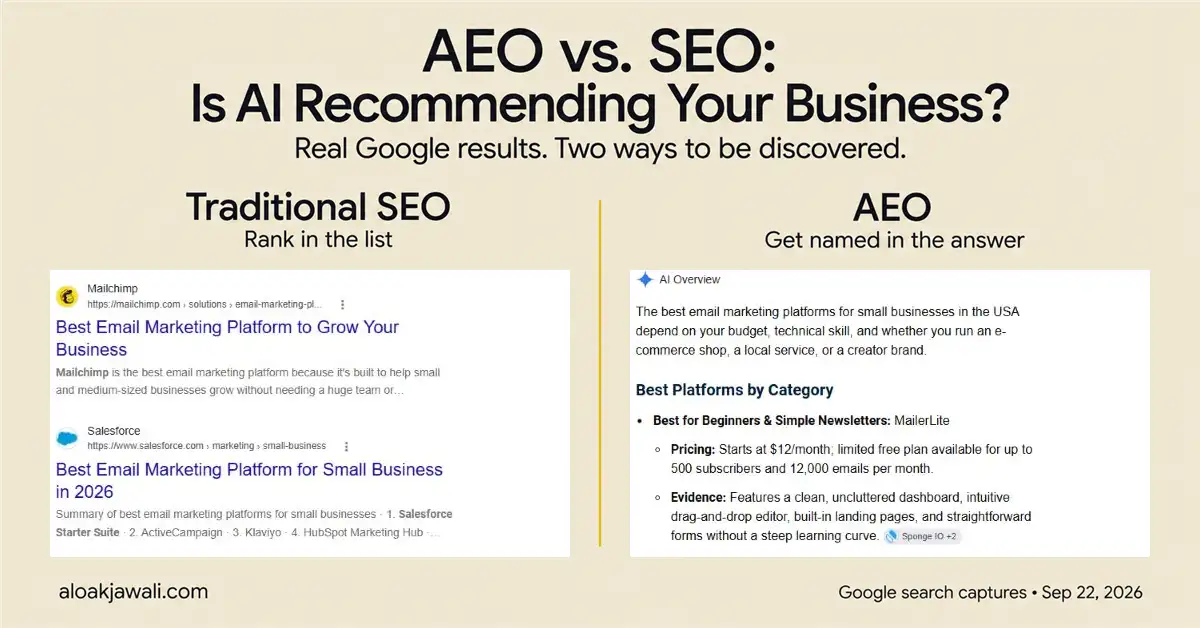
SEO covers discovery and visibility in search engines. AEO describes work aimed at appearing in direct answers, including answers that mention a business or link to a source. A brand mention and a citation are different outcomes: an answer can name your company without linking to your website.
| Comparison | SEO | AEO and AI visibility |
| Discovery channels | Search listings and other search features | Direct answers and AI conversations |
| Business goals | Relevant visibility, visits, and business inquiries | Accurate mentions, useful citations, visits, and inquiries |
| Useful content | Pages that resolve the customer’s question | Clear answers supported by evidence and accessible source pages |
| Measurement | Search impressions, clicks, conversions, and revenue | Mentions and citations in a defined sample, referral visits, and conversions |
| Uncertainty | Future rankings and traffic | Whether a particular response will include your business |
Both approaches involve individual pages and the business behind them. Treating SEO as only keywords and AEO as only branding hides that overlap.
Does AEO replace SEO?
No. Google says its AI search experiences rely on its core search ranking and quality systems. Its guidance treats optimization for those experiences as SEO. Google generative AI optimization guide
That makes your existing website the starting point. Check that customers can find your services, understand your offer, and contact you. Then review whether search engines can access and index the pages that explain it.
For example, an accounting firm should explain the businesses it serves, the work included in an engagement, pricing factors, and how onboarding works. A general article about the importance of accounting cannot answer those buying questions.
Which crawlers should you allow?
Check each crawler’s purpose before changing access rules. Search discovery and model training use different controls.
| Provider | Search or retrieval access | Training access |
| Googlebot handles crawling for Google Search, including its AI features | Google-Extended controls certain uses outside Google Search | |
| OpenAI | OAI-SearchBot supports ChatGPT search; ChatGPT-User handles certain user-directed visits | GPTBot collects content for potential use in model training |
| Anthropic | Claude-SearchBot supports search; Claude-User handles user-directed retrieval | ClaudeBot collects content for model development |
Allowing a training crawler does not guarantee a search citation. Blocking training access does not automatically mean you have blocked the provider’s separate search crawler. Review the provider’s current instructions and your firewall rules before making changes. Google crawler controls, OpenAI crawler documentation, Anthropic crawler documentation
What should you add to your content?
Add details that help someone choose, act, or check a claim. The right evidence depends on the page.
| Page | Useful addition | What the reader learns |
| Service page | Scope, exclusions, pricing factors, and project steps | Whether the service fits their needs |
| Case study | Starting conditions, actions, results, and limitations | What happened and how to interpret it |
| Product page | Specifications, original photos, and compatibility limits | Whether the product will work for them |
| Location page | Actual service area, local staff, and location-specific details | Whether you serve their area |
| Educational article | A worked example, worksheet, or documented test | How to apply the advice |
Keep examples separate from client results. If a calculation is hypothetical, label it. If you report a result, explain the measurement period and the source of the data. Get permission before identifying a client or sharing confidential details.
Name the author, describe relevant experience accurately, and link to sources that support factual claims. A byline creates accountability; it does not establish that every statement is correct.
How do you measure AI visibility?
Use a repeatable sample and track business outcomes alongside it. A single favorable answer tells you little about visibility across different questions, users, and sessions.
Start with customer questions about your service, location, pricing, alternatives, and suitability. Keep the wording consistent when you repeat the check. Record the platform, date, location settings, whether web search was used, and the answer itself.
Use this worksheet:
| Field | What to record |
| Customer question | The exact prompt |
| Platform and date | Where and when you checked |
| Business mention | Whether the answer named your company |
| Website citation | Whether it linked to a page you own |
| Accuracy | Incorrect services, prices, locations, or other details |
| Other sources | Competitors and websites cited |
| Next action | The specific page or business detail to review |
Illustrative calculation: Suppose you check 20 questions on one platform. Your business appears in five answers, giving you a 25% mention rate in that sample. Your website is cited in two answers, giving you a 10% citation rate. These figures describe that test; they are not your share of the entire AI search market.
Repeat the same sample weekly for 4 weeks. Keep each platform’s results separate. If mentions increase but citations stay at 10%, investigate which sources the answers use before deciding what to change. Count each answer once for each metric, even if it repeats your name or links to several pages. With a sample this small, a single answer can change the result substantially; investigate a sustained pattern before attributing it to a website edit.
Track referral visits and completed inquiries in analytics too. Ask new leads how they heard about you. Some people will encounter your name in an answer and return through a different channel, so referral reports provide only part of the picture.
Google’s current optimization guide points site owners to its Generative AI performance report in Search Console. Check availability in your account and the report’s definitions before combining it with other metrics. Google measurement guidance
What should you do in the next 30 days?
Use this as a suggested work schedule, not a promise of results within 30 days.
First 7 days: establish the baseline. Check access and indexing for your main service pages. Review business details and test the inquiry process. Save your initial AI visibility sample and current search and conversion data.
Next 7 days: improve one priority page. Choose a page tied to a service you want to sell. Add missing scope, suitability, pricing factors, and supporting evidence. Put the answer to its main question near the beginning.
Final 16 days: publish, check, and document. Verify that the revised page works on mobile and that its links and forms work. Continue your scheduled visibility checks. Record the publication date and any other marketing changes that could affect results.
At the end of the month, decide what the evidence supports. If the page remains unindexed, investigate eligibility. If people visit but do not inquire, review the offer and contact process. If answers repeat incorrect business details, investigate the cited sources.
Should you pay for an AEO service?
Ask for a deliverable you can review: a technical audit, a content revision, a documented visibility sample, or a measurement setup. The proposal should explain what will change and how the provider will evaluate it.
Before hiring, request these details in writing:
- The pages and customer questions included in the project.
- Evidence supporting each proposed change.
- Separate reporting for business mentions and website citations.
- A method for tracking qualified inquiries from the work.
- A review date and next steps if the first changes produce no measurable improvement.
No provider controls whether an AI system recommends your business in a particular answer.
Do you need special AI files or Schema?
Google says it does not require special AI markup or an llms.txt file for its search experiences. Use structured data where it accurately describes visible content and supports an applicable search feature. Google guidance on AI optimization myths
Prioritize a useful page over an extra file. A customer should be able to understand your offer, check your evidence, and take the next step.
Where should a small business start?
Choose one valuable service page, identify the question it leaves unanswered, and fix that gap. Establish a baseline before publishing so you have something to compare later.
Aloak Jawali helps small and midsize businesses improve visibility across search engines and AI answer experiences, with a focus on qualified leads. Explore the AI search and AEO guides.