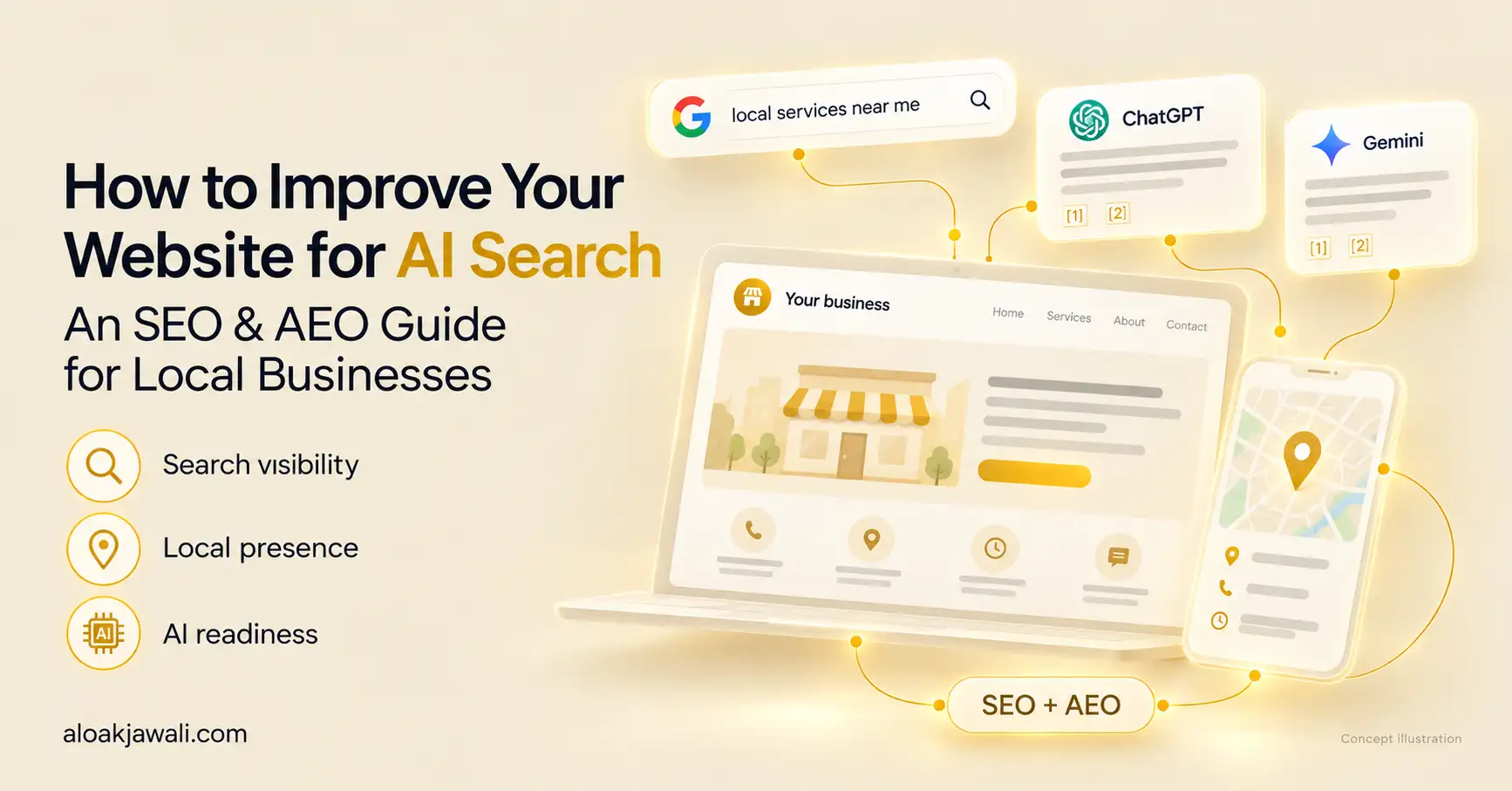
Improve your local search visibility, strengthen your website, and help customers discover your business across Google Search, Google Maps, ChatGPT, Perplexity, Gemini and other AI-powered search experiences.
In my experience working with local businesses, the ones that win today aren’t just ranking on Google. They’re showing up everywhere customers search.
Think about how people look for a salon now. Someone might ask ChatGPT, “What’s the best affordable hair salon near me for balayage?” or “Where can I get a blowout before graduation?”
Someone else might ask Gemini, “Which highly rated salons near me are open this weekend?” These customers are not scrolling through ten blue links. They’re getting a short list of recommendations, and if your business isn’t on it, you’ve lost the booking before they ever saw your name.
I’ve organized this guide into five key priorities and a practical 4-week roadmap, so you know both what to focus on and when to do it. The goal is to get found on Google Search, Google Maps, ChatGPT, Perplexity, Gemini and other AI search tools, and turn that visibility into more phone calls, qualified leads, and booked appointments.
1. The Problem: Your Business Depends on Google, but Is Your Website Ready for AI Search?
For many local businesses, online discovery depends heavily on Google Search, Google Maps and Google Business Profile.
When customers need a service nearby, they often search for terms such as:
- Best cleaning services near me
- Emergency towing service in my area
- Travel agency near me
- Best medical clinic nearby
- Jewellery store near me
- Grocery store or supermarket nearby
- Coffee shop or pizza restaurant near me
- Pet supplies near me
- Pharmacy open nearby
- Best beauty parlour or hair salon in my area
- Tourist attractions near my location
Traditionally, local visibility has depended on factors such as relevance, distance, prominence, reviews, website quality and the accuracy of business information.
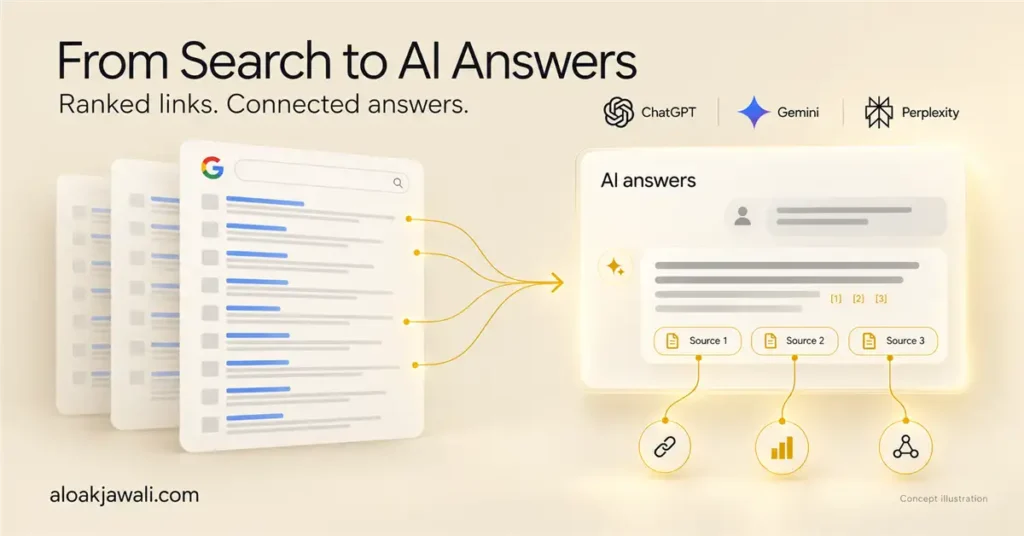
Search behaviour is evolving. Customers increasingly use conversational queries and AI-powered search experiences to compare businesses, understand services and discover recommendations.
They may ask:
- Which towing company offers emergency roadside assistance in my area?
- Recommend a reliable cleaning service for a deep clean.
- Which medical clinic provides the services I need?
- Where can I find a good coffee shop with outdoor seating?
- Which travel agency can help me plan a customised holiday?
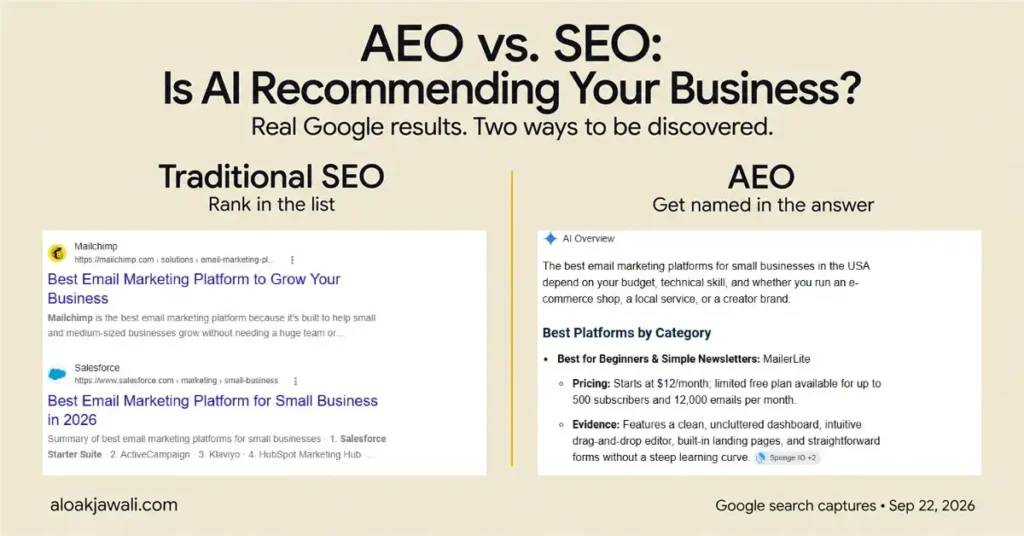
The challenge is no longer limited to ranking for keywords. Your business also needs to be clearly understood and considered by the systems that help customers make decisions.
If your website provides little information beyond a phone number, a list of services and a contact form, search engines and AI systems may have limited information to understand what differentiates your business.
That does not automatically mean your business will be excluded from AI answers. However, it can leave important gaps in your online presence.
2. Why This Matters Even More for Small Websites and Local Businesses
You do not need a 100-page website to build a strong local search presence.
A one-page website or a website with five to ten pages can be a valuable starting point. The challenge is whether those pages communicate enough useful, accurate and specific information about your business.
This becomes particularly important when your business relies heavily on Google Business Profile, Google Maps, local searches, phone calls and walk-in customers.
The risks of relying mainly on Google Business Profile
Your Google Business Profile is an important local discovery asset, but it should not be your entire digital strategy.
1. Limited control over your online presentation
Your profile operates within Google’s platform. Your website gives you more control over how you explain your services, demonstrate expertise and communicate your value proposition.
2. Limited space to explain your services
A business profile may communicate your basic services and contact details, but a well-structured website can explain service options, pricing factors, processes, locations, qualifications and frequently asked questions in greater depth.
3. Missed opportunities to answer specific questions
Customers may search for a very particular service or problem. If your website does not address that need clearly, you may miss an opportunity to demonstrate relevance.
4. Limited differentiation from competitors
If your website looks and reads like every other local business website, customers and search systems have fewer reasons to recognise what makes your business different.
5. Less visibility into AI-driven discovery
Google rankings alone do not tell you whether your business is mentioned or cited in AI-generated answers. AI visibility needs to be evaluated separately.
Is a one-page website enough for AEO?
A one-page website can be sufficient for a narrowly focused business with one primary service and a clearly defined service area.
However, if your business offers several services, serves multiple locations or answers different customer needs, dedicated service pages may provide a better structure.
The objective is not to create more pages for the sake of SEO. It is to give each important service or customer need an appropriate, useful destination.
Who should prioritise local SEO and AEO?
This approach is particularly relevant to businesses such as:
- Home services: cleaning companies, plumbing services, electricians and maintenance providers.
- Automotive services: towing companies, roadside assistance providers and vehicle repair businesses.
- Healthcare: medical clinics, dental practices and pharmacies.
- Retail: jewellery stores, grocery stores, supermarkets and pet supply stores.
- Food and hospitality: coffee shops, noodle shops, pizza restaurants and other local dining businesses.
- Personal care: beauty parlours, hair salons and wellness businesses.
- Travel and tourism: travel agencies, tour operators and tourist attractions.
If your customers search for a service, compare local options and then call, visit or book, your website and business profile should work together.
3. Your Website: The Foundation of Your SEO and AEO Strategy
Before creating more content or implementing advanced structured data, evaluate whether your existing website clearly communicates the essential information about your business.
I recommend prioritising the following improvements.
Priority 1: Clearly explain who you are and what you do
Your homepage should immediately communicate:
- Your business name and primary service.
- The products or services you offer.
- Your primary location and service area.
- The customer problems you solve.
- What differentiates your business.
- How customers can contact you or take the next step.
Avoid vague headlines that sound impressive but fail to explain the business.
For example, instead of:
“Your Trusted Partner for Excellence”
Use:
“Professional Cleaning Services for Homes and Businesses in [City]”
The second headline establishes the service, audience and location more clearly.
Priority 2: Create dedicated pages for important services
If you offer multiple services, consider giving each major service its own useful landing page.
For example, a towing company might need:
- Emergency Towing Services
- Flatbed Towing
- Accident Recovery
- Roadside Assistance
- Junk Car Removal
A cleaning company might need:
- Residential Cleaning
- Deep Cleaning
- Move-In and Move-Out Cleaning
- Commercial Cleaning
Each page should contain information specific to that service. Avoid creating multiple pages that simply repeat the same text with different city names.
Priority 3: Strengthen your local relevance
Help customers understand where you operate and whether your business can serve their location.
Include accurate information about:
- Your business address, where applicable.
- The cities and areas you genuinely serve.
- Local service availability.
- Opening hours and contact information.
- Location-specific customer needs.
- Relevant local experience, examples and testimonials.
For service-area businesses that do not receive customers at their address, make sure the website and Google Business Profile represent the business accurately.
Priority 4: Make contact and conversion easy
A website should not simply attract visitors; it should help them take action.
Depending on the business, useful conversion elements may include:
- Click-to-call buttons.
- WhatsApp contact options.
- Appointment booking.
- Request-a-quote forms.
- Directions and opening hours.
- Service-specific enquiry forms.
Place relevant calls to action where customers are likely to need them.
Priority 5: Add credible proof
Build trust with real business information, not unsupported claims.
Where applicable, include:
- Genuine customer testimonials and reviews.
- Original photographs of your team, premises, products or completed work.
- Relevant qualifications, licences or certifications.
- Clear service policies and pricing information.
- Case studies and examples of completed work.
- Accurate business history and contact details.
Do not invent testimonials, certifications, response times or service guarantees.
4. How I Would Restructure Website Content for AEO
Answer Engine Optimization is about making useful information easy for search systems and people to understand, retrieve and evaluate.
There is no guaranteed formula for earning an AI citation. However, a clear content structure helps establish what your business offers and which customer questions your pages can answer.
Recommended structure for a local service page
Consider an emergency towing company as an example.
Page title: 24/7 Emergency Towing Services in [Service Area]
Section 1: Direct answer
Start with a concise explanation of the service, the area covered and how customers can request assistance.
Example:
“[Brand Name] provides emergency towing and roadside assistance in its confirmed service areas around [location]. Contact our team to ask about availability and request assistance.”
Use only verified business information.
Section 2: Services provided
Explain the specific services available, such as vehicle breakdown towing, flatbed towing, accident recovery or roadside assistance.
Section 3: Who needs this service?
Describe common customer situations and explain which service may be appropriate.
Section 4: Service area
Identify the locations actually served and explain any limitations.
Section 5: Pricing and availability
Explain the factors that influence the cost, such as distance, vehicle type, recovery requirements and time of service. Publish specific prices or ranges only when they are accurate and supportable.
Section 6: Frequently asked questions
Answer real customer questions, such as:
- How do I request emergency towing?
- What information should I provide when calling?
- Do you offer flatbed towing?
- Which locations do you serve?
- How is towing cost calculated?
- Is service available outside normal business hours?
Section 7: Trust and proof
Include genuine photographs, reviews, relevant credentials and practical information about the service process.
Section 8: Clear call to action
Make it easy for customers to call, enquire or request assistance.
Apply the same principle to other industries
For a medical clinic, focus on verified services, practitioners, appointment procedures, opening hours and patient information.
For a jewellery store, explain product categories, materials, customisation options, repair services and store policies.
For a restaurant, provide an accurate menu, opening hours, location, dietary information where verified and reservation details where applicable.
For a travel agency, explain destinations, trip types, booking processes, customisation options and relevant travel expertise.
The principle is simple: build pages around real services and genuine customer questions, rather than publishing generic content merely to target AI search.
5. Technical SEO Changes That Can Support AI Visibility
Good content cannot deliver its full potential if important pages are inaccessible, incorrectly indexed or technically confusing.
I recommend auditing the following areas.
A. Crawlability and indexability
Check that important pages can be discovered and accessed by relevant crawlers.
- Review
robots.txtrules. - Check whether important pages are blocked by
noindex, authentication or firewall restrictions. - Validate HTTP status codes and redirect behaviour.
- Check canonical tags for important pages.
- Maintain an accurate XML sitemap.
- Verify that essential content is available in the rendered page, not hidden behind inaccessible interactions.
- Monitor indexing in Google Search Console.
For ChatGPT Search specifically, review the official guidance for OAI-SearchBot and ensure it is not unintentionally blocked by your server or content delivery network. Other AI platforms may use different crawlers and policies.
B. Structured data and schema markup
Structured data helps search systems interpret information about a business and its pages.
Depending on the website, relevant schema types may include:
LocalBusinessor an appropriate, more specific subtype.Organization.Service.Product, where relevant and eligible.BreadcrumbList.WebSite.
Use valid properties that accurately reflect the visible content. For local businesses, include appropriate business details such as name, address where applicable, phone number, URL, opening hours and service information.
Do not assume that adding schema automatically improves rankings or guarantees citations in AI-generated answers.
Also, FAQ content can be valuable for users without requiring FAQ schema on every page. Implement structured data according to current search-engine documentation and eligibility requirements.
C. Internal linking and website architecture
Create a logical structure connecting your homepage, service pages, location pages and useful resources.
For example:
Homepage → Residential Cleaning → Deep Cleaning → Relevant supporting information
(such as a deep cleaning checklist or “What’s included in a deep clean?” guide).
Use descriptive anchor text and ensure important pages are reachable through standard links.
D. Mobile experience and performance
Many local searches happen on mobile devices.
Check:
- Core Web Vitals and page loading performance.
- Mobile usability and readable typography.
- Tap targets and click-to-call functionality.
- Navigation and form usability.
- Broken links and technical errors.
- HTTPS and basic website security.
E. Business identity and external consistency
Make sure your business information is consistent across your website, Google Business Profile and credible external sources.
Review business name, address, phone number, opening hours, service area and official website links.
Use accurate business categories and service details. Build genuine local citations and relevant third-party references instead of relying on mass directory submissions.
F. Should you create an llms.txt file?
You may encounter recommendations to add llms.txt to help AI systems understand your website. It is not a universal requirement for AI search visibility, and there is no guarantee that AI search engines will use it.
I would prioritise crawlability, useful content, correct business information, internal linking and credible external signals before investing significant effort in experimental files or AI-specific technical shortcuts.
6. A Practical 30-Day SEO and AEO Roadmap
A focused 30-day programme can establish the technical and content foundations for improving visibility. Actual ranking and citation changes may take longer, and results depend on the business, competition, website condition and search platform.
Week 1: Audit and establish a baseline
Objective: Identify what is preventing your website from communicating its value effectively.
Key activities:
- Audit technical SEO, crawlability and indexing.
- Review the homepage and existing service pages.
- Check Google Business Profile completeness and accuracy.
- Review local competitors and their service-page structures.
- Identify priority keywords and customer questions.
- Test a consistent set of AI search prompts.
- Record existing rankings, traffic, calls and enquiries where data is available.
Deliverable: A prioritised SEO and AEO audit with baseline visibility measurements.
Week 2: Fix the website foundations
Objective: Make the website easier to crawl, understand and use.
Key activities:
- Fix critical crawl and indexing issues.
- Improve homepage messaging and service descriptions.
- Update title tags, headings, metadata and internal links.
- Implement appropriate structured data.
- Improve mobile usability and conversion paths.
- Correct inconsistent business information.
- Verify relevant crawler access.
Deliverable: A technically improved website with clearer business and service information.
Week 3: Improve content and authority
Objective: Answer customer questions more comprehensively and establish stronger evidence of expertise.
Key activities:
- Improve the most important service pages.
- Create dedicated pages for genuinely distinct services.
- Add accurate service-area information.
- Develop useful FAQs based on real customer needs.
- Add original photographs, case studies and genuine reviews where appropriate.
- Strengthen internal links.
- Review relevant local directories and credible industry references.
Deliverable: Better service content and a stronger local business presence.
Week 4: Measure, learn and prioritise
Objective: Understand what has improved and identify the next opportunities.
Key activities:
- Recheck technical issues and indexing.
- Review Google Search Console performance.
- Compare baseline and current AI citation tests.
- Review relevant competitor citations and source pages.
- Analyse organic leads, calls and referral traffic.
- Document completed work and outstanding priorities.
- Develop the next 60-day improvement plan.
Deliverable: A performance report with measurable observations, outstanding issues and recommended next actions.
7. How to Measure Whether Your Brand Is Getting Cited by AI
One of the biggest mistakes in AEO is treating the publication of optimised content as proof of success.
You need a repeatable measurement process.
Step 1: Establish your baseline
Create a set of relevant questions customers might ask AI systems.
For example:
- Which emergency towing companies serve [location]?
- Recommend a reliable cleaning company in [location].
- Which medical clinics in [location] offer [service]?
- Where can I find a jewellery store offering [product or service] nearby?
- Which travel agencies specialise in [destination or holiday type]?
Run these prompts on the platforms relevant to your customers and document the results.
Step 2: Track four separate visibility metrics
1. Brand mentions
How often does the AI answer name your business?
2. Website citations
How often does the AI answer link to your website as a source?
3. Relevant prompt coverage
For how many of your target questions does your business appear?
4. Referral traffic and conversions
How much traffic comes from AI platforms, and does it generate meaningful enquiries, calls or bookings?
A brand mention without a website citation is different from a clickable citation. Both may matter, but they should be tracked separately.
Step 3: Maintain an AI visibility tracker
Record the date, platform, prompt, location context, brand mention, website citation, competitor mentions and cited source URLs.
Repeat the tests periodically under reasonably consistent conditions. AI answers can change between runs, and personalisation or location may affect results.
Step 4: Connect visibility to business outcomes
Use Google Analytics or another analytics platform, Search Console, call tracking and enquiry records to evaluate performance.
Monitor:
- Organic search clicks and impressions.
- Local search visibility where measurable.
- Qualified website enquiries.
- Phone calls and bookings.
- Referral traffic from AI platforms.
- Leads generated by organic search and local discovery.
Do not rely on a single AI citation score. The goal is to improve relevant visibility and customer acquisition, not simply increase the number of mentions.
8. My Recommendation as an SEO/AEO Strategist
If your business has a one-page website or a website with up to ten pages and relies heavily on Google Business Profile, I would not recommend starting by publishing dozens of blog posts or implementing every new AI optimisation technique.
I would prioritise the following sequence:
First: Build a strong local SEO foundation.
Ensure your business details are accurate, your Google Business Profile is complete, your important pages are indexable, and your website clearly communicates the services and locations you cover.
Second: Improve the quality and structure of your website.
Make the homepage specific, create dedicated pages for important services when justified, answer customer questions, and make contact or booking easy.
Third: Make the website easier for search systems to interpret.
Use appropriate structured data, logical internal links, clear page headings and consistent business information. Verify crawler accessibility and technical health.
Fourth: Strengthen credibility beyond your own website.
Develop genuine customer reviews, original evidence of your work, credible local references and relevant third-party mentions. Avoid artificial link schemes and fabricated business claims.
Fifth: Measure AI visibility alongside conventional SEO.
Track brand mentions, website citations, relevant query coverage, referral traffic and qualified leads. Use the findings to refine your strategy.
You do not need a massive website to begin improving SEO and AEO. You need a website that communicates the right information clearly, supports your local business identity, answers real customer questions and provides credible evidence of what you offer.
SEO helps your business become discoverable. AEO helps structure useful answers. Strong technical foundations, accurate business information and credible evidence support both.
There is no guaranteed way to make ChatGPT, Gemini, Perplexity or Google AI features cite your business. The objective is to improve the conditions that make your website useful, accessible and relevant when these systems retrieve information and generate answers.