Google algorithm updates are arriving faster than ever. On November 10, Google began rolling out the November 2026 core update, which applies globally and in all languages and may take up to two weeks to complete. It’s the third core update this year and the eighth ranking update on the Search Status Dashboard in 2026. On top of that, there are new Search Console reports, AI Mode changes and local search policy updates.
You don’t need to read 50 blogs to keep up. You need a few official sources that tell you what changed, and a few expert sources that tell you what it means. The 22 sources below cover both, and they work well alongside our complete SEO checklist.
Quick Answer: What Are the Best Sources to Track Google Algorithm Updates in 2026?
The best sources to track Google algorithm updates are Google’s own channels first: the Google Search Status Dashboard, which logs ranking updates and offers an RSS feed, and the Search Central Blog. Industry sites like Search Engine Journal, Search Engine Land and Search Engine Roundtable add context, while analysts and newsletters such as Glenn Gabe and SEOFOMO explain impact. In 2026, Google released its November core update on November 10, the third core update and eighth ranking update that year.
Key Takeaways
- Start with official sources. The Search Status Dashboard and Search Central Blog confirm Google algorithm updates before anyone else can.
- Use industry news sites (SEJ, Search Engine Land, Search Engine Roundtable) for context, timelines and early reports of volatility.
- Product help pages (Analytics, Business Profile) often change quietly. Trade press is usually how you hear about those changes.
- Tool vendor blogs and independent analysts are best for data-backed analysis after a Google core update, not breaking news.
- A 15-minute weekly check beats daily doomscrolling during rollouts.
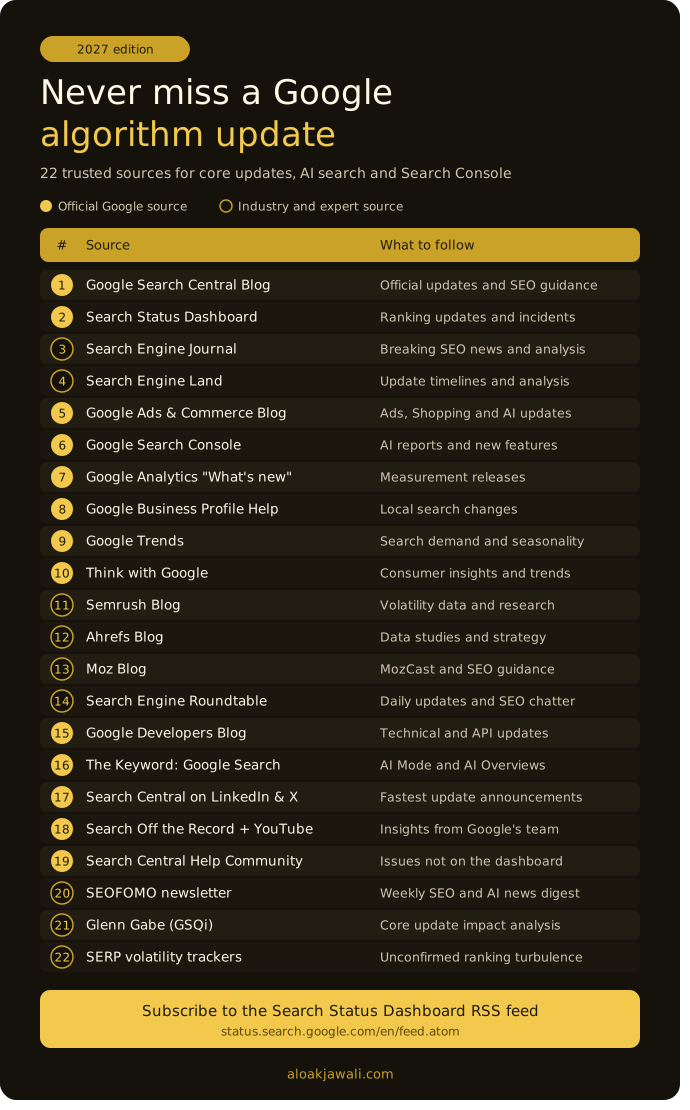
Quick Reference: 22 Sources to Track Google Algorithm Updates
| # | Source | Type | Best for |
|---|---|---|---|
| 1 | Google Search Central Blog | Official | Google search updates, policies, SEO guidance |
| 2 | Google Search Status Dashboard | Official | Ranking updates and search incidents |
| 3 | Search Engine Journal | Industry news | Breaking SEO news and analysis |
| 4 | Search Engine Land | Industry news | Google updates and search analysis |
| 5 | Google Ads & Commerce Blog | Official | Ads, Shopping and AI ad features |
| 6 | Google Search Console | Official tool | Your own performance and new reports |
| 7 | Google Analytics “What’s new” | Official | Analytics and measurement releases |
| 8 | Google Business Profile Help | Official | Local search and profile changes |
| 9 | Google Trends | Official tool | Search behavior and trending queries |
| 10 | Think with Google | Official | Consumer insights and marketing trends |
| 11 | Semrush Blog | Tool vendor | SEO research and update analysis |
| 12 | Ahrefs Blog | Tool vendor | SEO strategy and data studies |
| 13 | Moz Blog | Tool vendor | SEO fundamentals and industry guidance |
| 14 | Search Engine Roundtable | Industry news | Daily Google updates and community chatter |
| 15 | Google Developers Blog | Official | Technical updates and developer tools |
| 16 | The Keyword: Google Search blog | Official | AI Mode, AI Overviews and user-facing features |
| 17 | Google Search Central on LinkedIn & X | Official | Fastest update announcements |
| 18 | Search Off the Record + Search Central YouTube | Official | Background from Google’s Search Relations team |
| 19 | Google Search Central Help Community | Official forum | Problems not shown on the dashboard |
| 20 | SEOFOMO newsletter | Curated newsletter | One weekly digest of SEO and AI search updates |
| 21 | Glenn Gabe (GSQi) | Independent analyst | Core update impact analysis |
| 22 | SERP volatility trackers | Tools | Unconfirmed Google ranking updates |
Official Sources That Confirm Google Algorithm Updates
These are primary sources. When an update is confirmed, it’s confirmed here first.
1. Google Search Central Blog
developers.google.com/search/blog is where Google’s Search Relations team publishes Google SEO updates: policy changes, new features and documentation changes. In 2026 it announced a new spam policy for “back button hijacking” in April and a new location for Google’s crawler IP range files in March.
What to watch for: new spam policies, structured data changes, crawling changes, and anything starting with “Introducing.”
Core updates don’t always get a blog post, though. When the November 2026 update launched, neither the dashboard entry nor Google’s LinkedIn post named specific goals, and the Search Central blog had no post about it. That’s why source #2 matters.
2. Google Search Status Dashboard
If you follow only one source, make it the Google Search Status Dashboard. It’s the only place where Google algorithm updates are officially logged with start and end dates. It reports issues affecting many sites or users, and Google offers an RSS feed so you can get alerts automatically. Past issues and updates stay on the Summary and History page for five years.
The ranking history is useful when your traffic drops and you want to know whether it lines up with an update. Google added the “Ranking” category in 2023, with history going back to 2020. In 2026, the dashboard logged spam updates in June, August and September plus the May core update, alongside March and November core updates.
5. Google Ads & Commerce Blog
blog.google/products/ads-commerce is the official channel for Google Ads, Shopping and Merchant Center news. It matters for SEOs too, because AI-powered shopping and ad formats increasingly share space with organic results. Big announcements tend to cluster around Google Marketing Live; the 2026 keynote was delivered by Philipp Schindler on May 20, 2026.
6. Google Search Console
Search Console is a tool, not a news feed, but it’s where Google’s changes show up in your own data. Many of 2026’s biggest SEO announcements were Search Console features:
- On June 3, 2026, Google launched Search Generative AI performance reports, with separate views for Search and Discover showing impressions in AI Overviews, AI Mode and generative features in Discover.
- Google also added a toggle that lets site owners decide whether their site appears in and helps ground responses in those generative AI features. After a gradual rollout, both became available to every Search Console account worldwide.
- A new “platform properties” type lets creators monitor how Instagram, TikTok, X and YouTube posts perform in Search and Discover, even without their own website.
- In September, Google added reporting for image-based searches from Lens, Circle to Search, image uploads and Chrome’s “Search this image” option.
Tip: New Search Console features are announced on the Search Central Blog (#1), so following that blog covers both.
7. Google Analytics “What’s New”
The official changelog lives at support.google.com/analytics/answer/9164320. It lists the year’s releases, with older ones moved to a separate archive. Recent entries include AI tooling; Google announced Analytics Advisor, a conversational AI assistant powered by Gemini.
Check it monthly. Reporting changes can quietly break dashboards or change how a metric is calculated.
8. Google Business Profile Help
For local SEO, the Business Profile Help Center is the source of truth, but Google often updates it without any announcement. In March 2026, Google added a new Offers metric to the performance metrics help page, even though the data wasn’t yet visible in most accounts. Google has a history of documenting features before they’re widely available, or months after they’ve quietly launched.
The help center also has an “Ask Google Help” AI chatbot in the lower-right corner for quick questions. For the bigger picture on local visibility, see our guide to AEO for local businesses.
9. Google Trends
Google Trends doesn’t announce algorithm changes. It shows how search demand is changing. Use it to tell an algorithm hit apart from a seasonal dip: if interest in your topic fell 40% in the same week your traffic fell 40%, the core update probably isn’t the cause.
10. Think with Google
Think with Google has moved. It now lives at business.google.com/think, where it’s organized into Consumer Insights, Search & Video, AI Excellence, Future of Marketing and Measurement. Expect consumer research and Google’s view of where search is heading, not technical SEO news. Update any old thinkwithgoogle.com bookmarks.
15. Google Developers Blog
developers.googleblog.com covers APIs, Chrome, Gemini developer tools and web platform changes. It’s most useful for technical SEOs and developers whose work touches rendering, Core Web Vitals or Google APIs.
Industry News Sites That Explain Google Algorithm Updates
Official sources tell you that something happened. These sites track the impact, collect data from ranking tools, and explain what it means in practice.
3. Search Engine Journal
SEJ is quick to cover every confirmed Google core update and often adds context Google leaves out. Its November 2026 coverage, for example, pointed out that a full two-week rollout would end around November 24, just before Thanksgiving, Black Friday and Cyber Monday, so retailers comparing post-update traffic would be comparing holiday traffic to a normal week. Bookmark SEJ’s Google algorithm history page.
4. Search Engine Land
Search Engine Land publishes rollout start and completion articles for every confirmed update, each with a running timeline of past core updates. It’s useful when you need dates for a client report.
14. Search Engine Roundtable
Barry Schwartz’s Search Engine Roundtable is often the fastest place to read about the latest Google algorithm update, plus smaller changes: help-doc edits, SERP tests, and community reports of volatility before Google confirms anything. It’s also how many people hear about quiet Business Profile changes, such as when Google added a new section to the Business Profile performance metrics documentation.
Tool Vendor Blogs: Data and Deep Analysis
These blogs are rarely first with news. Their value is analysis backed by large datasets, usually published days or weeks after an update finishes.
11. Semrush Blog
The Semrush Blog publishes update analysis using its own volatility data (Semrush Sensor), plus keyword and competitive research guides.
12. Ahrefs Blog
The Ahrefs Blog is known for data studies and practical strategy, including link building, content, and more and more AI search visibility.
13. Moz Blog
The Moz Blog is a long-running source for SEO fundamentals and industry commentary. Moz also maintains MozCast, a daily “weather report” for Google SERP volatility.
7 More Sources the Infographic Misses
16. The Keyword: Google’s Search Blog
The Search Central Blog (#1) is written for site owners. AI search updates that change what searchers see, especially AI Mode and AI Overviews, are announced on Google’s main blog at blog.google/products/search. Google said at I/O 2026 that AI Mode had passed one billion monthly users within a year of launch, so these product changes now affect how your pages get seen.
The pace is fast. In mid-November alone, Google announced it was bringing a Gemini 4 model into AI Mode, and on November 18 it rolled out temporary threads in AI Mode globally, which keep those conversations out of search history and recommendations. To make your content ready for these features, work through our 27 AEO best practices.
17. Google Search Central on LinkedIn and X
Google often posts a Google algorithm update today on social before anywhere else. The March 2026 core update was announced on Google’s X and LinkedIn pages, and the November 2026 core update was also announced on LinkedIn by the Search Central account. Follow Search Central on LinkedIn and on X, and turn on notifications.
18. Search Off the Record Podcast and the Search Central YouTube Channel
Search Off the Record is Google’s podcast with the Search Relations team. Episodes explain the thinking behind launches, Search Console feature priorities, and current projects. It comes out every two weeks, and 2026 episodes have covered topics such as whether you still need a website in 2026 and how AI is changing Google Search.
The Search Central YouTube channel hosts the video versions plus conference talks. In October 2026, Google also launched curated YouTube playlists as learning paths for Search fundamentals and technical SEO, which are useful for training new team members.
19. Google Search Central Help Community
When something is wrong but the Status Dashboard shows nothing, Google directs website owners to the Search Central Help Community. It’s also a useful early-warning system: if several site owners report the same indexing or Search Console bug, you’ll often see it there before it’s confirmed.
20. SEOFOMO Newsletter (Aleyda Solis)
If you’d rather read one email than ten websites, SEOFOMO is one of the best SEO news sources. It’s a free weekly newsletter curated by international SEO consultant Aleyda Solis, covering SEO and AI search news, tools, events, guides and jobs. It reports a readership of more than 45,000 SEOs. Aleyda also runs AI Marketers, a separate weekly newsletter focused on AI search news, including AI Overviews and ChatGPT.
21. Glenn Gabe (G-Squared Interactive)
When a core update hits, Glenn Gabe’s analysis is usually among the first worth reading. He posts daily “Core Update Notes” on X, Bluesky and LinkedIn, with charts showing rank and traffic changes for specific sites. These notes are one of the fastest independent reads on how Google algorithm updates are affecting real sites. During the May 2026 core update, for example, he reported impact across verticals and countries. Longer write-ups are on gsqi.com, and his podcast SEO From The Front Lines covers algorithm updates and AI search.
22. SERP Volatility Trackers
Tools like Semrush Sensor (#11) and MozCast (#13) estimate daily turbulence in Google ranking updates. Use them to spot unconfirmed Google algorithm updates, then confirm on the Status Dashboard. Treat them as a signal, not proof. During the November 2026 core update, Search Engine Roundtable noted that the reaction seemed quieter than usual, and suspected third-party tracking tools were having trouble monitoring the ranking changes.
A 15-Minute Weekly Routine for Tracking Google Algorithm Updates
If you’ve been wondering how to track Google updates without it taking over your week, this routine covers most of what matters:
- Monday (5 minutes): Check the Google Search Status Dashboard (or its RSS feed), the Search Central Blog, and Google Search Central on LinkedIn or X.
- Wednesday (5 minutes): Skim headlines on one news site (SEJ, Search Engine Land or Search Engine Roundtable).
- Friday (5 minutes): Look at Search Console performance, including the generative AI reports, and compare against the dashboard timeline.
- Weekend: Read the SEOFOMO newsletter for anything you missed.
- Monthly: Review the Analytics “What’s new” page, Business Profile Help (if you do local SEO), and one in-depth analysis from Semrush, Ahrefs, Moz or Glenn Gabe.
If an update hits during a rollout, wait before acting. Google’s core updates guidance says to wait at least a full week after the rollout finishes, then compare that week’s Search Console data with a week from before the rollout started.
Frequently Asked Questions
How do I know if Google algorithm updates affected my site?
Line up your Search Console traffic against the dates on the Google Search Status Dashboard. If the drop starts during a listed rollout and isn’t explained by seasonality (check Google Trends), the update is a likely cause. Wait until the rollout is complete before you draw conclusions.
What’s the fastest way to get notified about a Google core update?
Subscribe to the Search Status Dashboard RSS feed and follow Google Search Central on LinkedIn or X. Google’s own channels confirm updates before anyone else can.
Does Google announce every algorithm change?
No. The dashboard lists major ranking updates, such as core and spam updates. Google also makes smaller changes constantly without announcing them. Industry sites like Search Engine Roundtable often report unconfirmed volatility based on ranking tools and community reports.
Is a Google core update a penalty?
No. Core updates reassess content across the web, so some pages rise and others fall. A drop doesn’t mean you broke a policy. Spam policy violations are handled separately.
Conclusion
Keeping up with Google algorithm updates is about structure, not volume. Use official sources to confirm what changed, industry news for context, and analysts and tool vendor blogs for data. With the November 2026 core update still in the news and AI search reshaping how results look, a reliable 15-minute weekly routine will keep you ahead of most of your competitors.
Your next step: Follow aloakjawali.com on Feedly to get our breakdown of every new Google algorithm update, AI search change and SEO checklist as soon as it’s published. It takes 30 seconds. Then run your site through our free AI Search Checker to see how ready it is for both Google and AI search