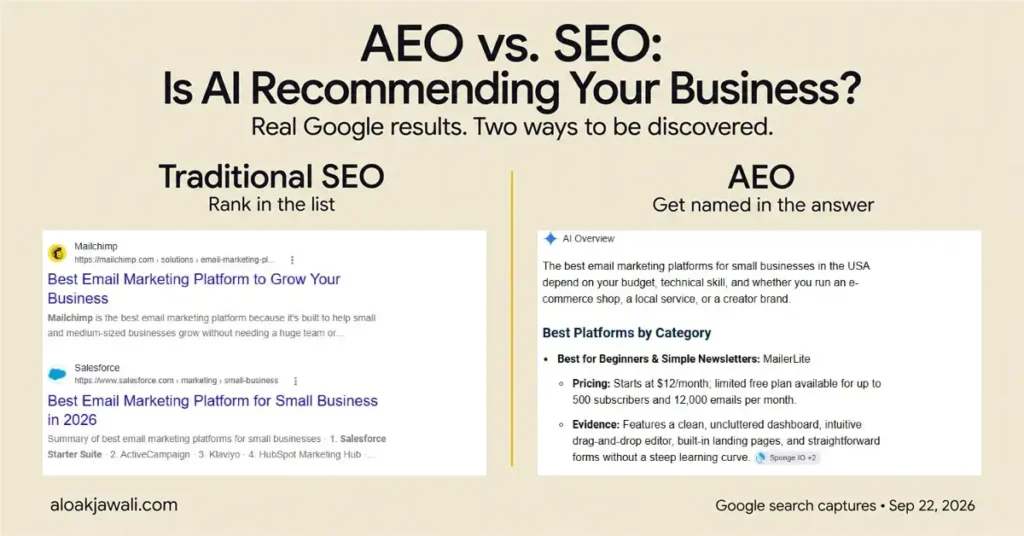
Technical SEO is undergoing a massive shift. Search engines are no longer just indexing keywords; they are parsing raw code, evaluating entity relationships, and answering complex queries directly inside generative AI interfaces like Google AI Overviews, Perplexity, and ChatGPT.
Most SEO workflows still rely on disconnected spreadsheets and fragmented tools. However, Anthropic’s Claude changes the game. Thanks to its 200,000-token context window and exceptional code interpretation, Claude can ingest entire server log exports, raw HTML source files, complex sitemaps, and rendered DOM snippets without losing context.
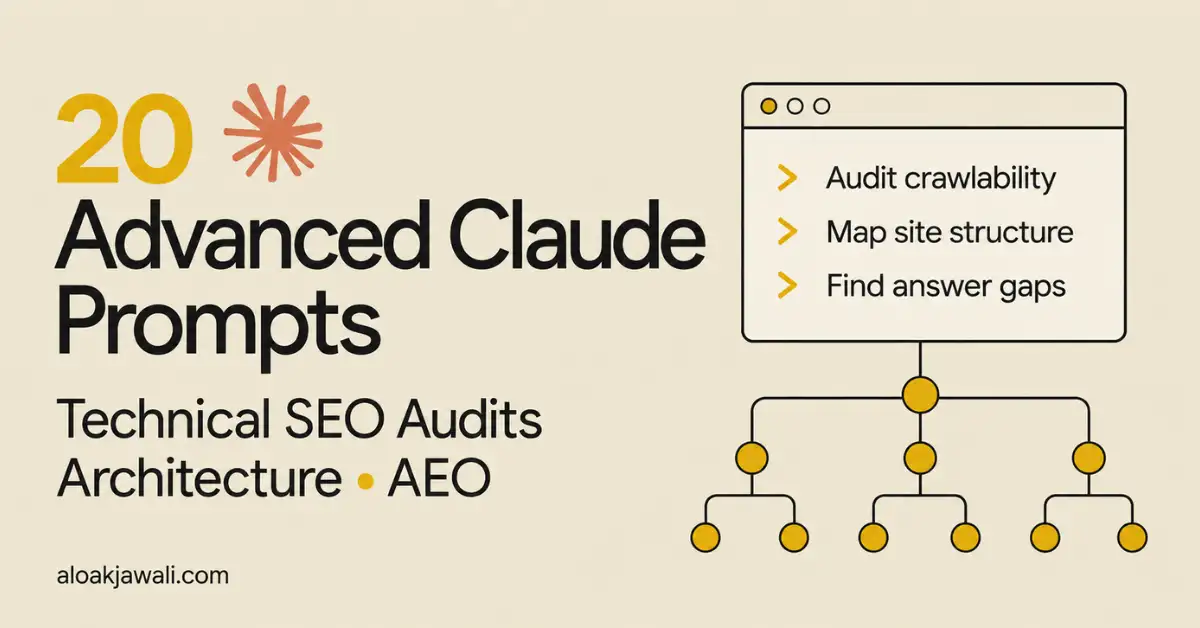
Whether you are a seasoned enterprise technical SEO engineer or a site owner trying to resolve indexing errors on your own, this guide provides 20 battle-tested, copy-paste Claude prompts. Use them to diagnose crawl issues, rebuild site architecture, fix schema, and optimize for both traditional SERPs and modern Answer Engine Optimization (AEO).
Why Claude Excels at Technical SEO
While standard chatbots struggle with long documents and truncate code blocks, Claude offers three distinct advantages for technical audits:
- Massive Context Handling: You can upload an entire CSV export of 404 errors, redirect chains, or server access logs directly into the prompt.
- Deterministic Code Analysis: Claude evaluates raw HTML vs. rendered client-side JavaScript (DOM) without hallucinating missing tags.
- Structured Technical Output: It reliably formats developer-ready documentation, regex rewrite rules, and valid JSON-LD schema.
Category 1: Crawlability, Directives & Indexing Diagnostics
1. The Raw Technical Audit Triage Prompt
- Why it matters: Audit tools like Screaming Frog or Ahrefs produce overwhelming lists of issues. Non-technical stakeholders often don’t know what to fix first.
- How to run: Export your crawl error table as a CSV or copy-paste the top error rows into Claude.
Act as a Senior Technical SEO Architect. I am auditing [Insert URL / Domain]. Here is a raw export of technical SEO errors from my audit tool:

[Paste crawl error data, e.g., 404s, 5xx errors, redirect chains, missing canonicals, or broken assets]

Analyze these issues and prioritize them based on their direct risk to Google's crawl budget, indexation, and organic rankings. For each issue:
1. Identify the Root Cause in plain English.
2. Assign a Priority Level (Critical, High, Medium, Low).
3. Provide a Step-by-Step Action Plan to resolve it.
4. Specify whether this requires developer intervention or can be fixed via CMS settings.
2. Resolving “Crawled – Currently Not Indexed” & “Discovered” Statuses
- Why it matters: Google Search Console flags these two issues when it encounters crawl bottlenecks or content quality thresholds.
- How to run: Export your URLs from GSC under the “Page indexing” tab and paste them below.
Act as an Enterprise Technical SEO Consultant. Here is a list of URLs from my website currently flagged in Google Search Console under Page Indexing:

Status: [Specify either: "Discovered – currently not indexed" OR "Crawled – currently not indexed"]
[Paste URL list along with page titles or page categories]

Analyze these patterns and tell me:
1. If "Discovered": Is this a crawl budget deficit, server performance limitation, or internal link depth problem?
2. If "Crawled": Is this an indicator of thin content, programmatic duplication, or weak search intent alignment?
3. Group these URLs by their likely root cause and provide an actionable triage roadmap to get them moved into the "Valid / Indexed" state.
3. Server Access Log File Crawl Budget Analyzer
- Why it matters: Log files show what Googlebot actually does on your server—not just what third-party crawlers simulate.
- How to run: Extract a sample of Googlebot hits from your server access logs (Apache, Nginx, or Cloudflare).
Act as a Senior Technical SEO Engineer. Here is a raw export of server access logs for Googlebot hits on my website:

[Paste sample log lines: IP, Timestamp, HTTP Method, Requested URL, Status Code, User Agent]

Analyze this log sample and report on:
1. Status Code Breakdown: What percentage of Googlebot requests return 200, 301/302, 404, or 5xx responses?
2. Directory Crawl Distribution: Which URL directories receive the highest crawl attention, and which priority sections are being ignored?
3. Crawl Waste Indicators: Are there excessive hits to faceted navigation, sorting parameters, staging paths, or non-critical static assets?
4. Concrete Recommendations: Provide specific robots.txt rules and server response optimizations to conserve crawl equity for high-converting pages.
4. Robots.txt, Noindex, and Canonical Conflict Detector
- Why it matters: Contradictory indexing directives confuse search crawlers and can silently de-index entire sections of your site.
- How to run: Paste your robots.txt file along with the meta tags of conflicting URLs.
Act as a Technical SEO Auditor. Here is my current robots.txt file and a sample of key URLs with their respective meta robots tags and canonical directives:

[Paste robots.txt content]
[Paste URLs with their current Canonical tag, Meta Robots directives, and internal linking status]

Audit these instructions for contradictions:
1. Are any URLs disallowed in robots.txt while also containing canonical tags or incoming internal links?
2. Are any pages set to `noindex` that serve as self-canonicals or canonical targets for other pages?
3. Do any robots.txt rules block critical CSS or JavaScript files required by Googlebot's Web Rendering Service (WRS)?

Provide a corrected robots.txt configuration and an implementation checklist for page-level meta directives.
5. URL Parameter & Faceted Navigation Triage
- Why it matters: Filtered pages on e-commerce and directory sites can generate thousands of duplicate URLs, depleting your crawl budget.
- How to run: Gather examples of dynamic query strings created by your site filters.
My website uses faceted filtering and URL query parameters for user sorting, filtering, and session tracking. Here are examples of parameter URLs generated by users:

[Paste parameterized URLs, e.g., ?sort=price, ?filter_color=blue, ?category=tech&session=abc]

Build a clean parameter handling framework:
1. Identify which parameters add organic search value (justifying dedicated indexable landing pages) and which represent duplicate content.
2. Define the proper handling mechanism for each parameter type (Canonicalization, Robots.txt Disallow, `noindex, follow`, or removal via CMS config).
3. Provide instructions on how frontend internal links within filter components should be coded to prevent search bots from falling into crawler traps.
Category 2: Code, Schema & Technical Rendering
6. Client-Side Rendering (CSR) vs. DOM Reconciliation Audit
- Why it matters: If your website runs on modern JavaScript frameworks (Next.js, Nuxt, React), search bots might miss content injected purely on the client side.
- How to run: Grab the HTML from “View Page Source” and compare it with the DOM from Chrome’s “Inspect Elements”.
I am auditing a JavaScript-heavy page on my site. Below are two versions of the HTML:

1. Raw Server Response HTML (View Page Source):
[Paste raw HTML]

2. Rendered DOM HTML (Browser Inspect Element):
[Paste rendered DOM]

Compare both versions and identify:
1. What critical content elements (H1-H3 headings, body text, image tags) exist only in the rendered DOM and are missing from the raw server response?
2. Are there internal links injected purely via client-side JavaScript that risk remaining unparsed during Google's first-wave crawl?
3. Were canonical tags, title tags, or structured data altered or injected after client-side scripts executed?
4. Recommend whether Server-Side Rendering (SSR) or Static Site Generation (SSG) adjustments are required for this template.
7. JSON-LD Structured Data & Entity Schema Generator
- Why it matters: Rich snippets and Google AI Overviews rely on well-formed Schema.org markup to extract structured answers.
- How to run: Paste an existing schema block to validate it, or specify your article type to build one from scratch.
Here is the schema markup code currently implemented on my page (or state "None, build from scratch" for [Insert Page Topic/Type]):

[Paste JSON-LD code block if available]

Review this code against the latest Schema.org specifications and Google Search Central guidelines:
1. Validate Schema types used (e.g., Organization, TechArticle, FAQPage, Person, Product).
2. Check for missing required properties and absent recommended fields that unlock rich snippets.
3. Fix syntax or nesting errors (such as missing commas, incorrect `@context`, or unclosed brackets).

Provide a completeness score out of 10, explain any vulnerabilities, and output the corrected, production-ready JSON-LD code.
8. Heading Hierarchy (Hn) & Metadata Structural Audit
- Why it matters: Clean heading hierarchies allow search engine bots and LLMs to parse content sections effortlessly.
- How to run: Copy the HTML of your <head> and <body> tags.
I am providing the HTML source code of my page [Insert URL]. Analyze the Hn heading structure (H1, H2, H3 hierarchy), the Title tag, and the Meta Description:

[Paste HTML source]

Identify:
1. Missing, duplicate, or multiple H1 tags.
2. Broken heading hierarchies (e.g., skipping from an H1 directly to an H3).
3. Title tag length, keyword placement, and click-through optimization.
4. Meta description alignment with search intent and length guidelines.

Present your findings in a Markdown table with columns: Element, Current State, Issue Detected, and Recommended Fix.
9. Core Web Vitals & Page Speed SEO Impact Audit
- Why it matters: Not every PageSpeed warning affects organic rankings. You need to know which metrics truly impact performance.
- How to run: Copy the diagnostic report from Google PageSpeed Insights.
Act as a Technical SEO and Web Performance Specialist. My website scored [X] on mobile and [X] on desktop in Google PageSpeed Insights. My field Core Web Vitals metrics are:
- Largest Contentful Paint (LCP): [X]
- Interaction to Next Paint (INP): [X]
- Cumulative Layout Shift (CLS): [X]

The flagged diagnostic issues include:
[Paste flagged items from PageSpeed Insights, e.g., render-blocking resources, unoptimized images, main-thread work]

Tell me:
1. Which of these issues directly harm search rankings under Google's Page Experience signals versus those that are purely UX recommendations?
2. Prioritize the fixes by SEO impact versus engineering effort.
3. Provide a step-by-step implementation guide my development team can follow immediately.
10. Hreflang & Internationalization (i18n) Tag Validator
- Why it matters: Incorrect hreflang tags cause search engines to display the wrong regional page versions to international users.
- How to run: Paste your alternate hreflang link tags.
I am auditing multi-regional and multi-language variations for my website. Here are the target URLs and the hreflang tags currently implemented in the HTML header:

[Paste `` code blocks]

Verify this implementation against Google's internationalization standards:
1. Confirm ISO 639-1 language codes and ISO 3166-1 Alpha-2 country codes are formatted accurately (e.g., en-US, es-ES).
2. Check for missing reciprocal self-referential tags across all URL variations.
3. Ensure an appropriate `x-default` URL is defined for unmatched visitor regions.
4. Output the fully corrected, production-ready `` snippet.
Category 3: Site Architecture, Redirects & Internal Linking
11. XML Sitemap & Orphan Page Architecture Analyzer
- Why it matters: Orphan pages (pages with zero internal links) rarely rank well and waste indexation potential.
- How to run: Export your sitemap URL list or website navigation structure.
Here is the URL structure and XML sitemap data for my site:

[Paste URL list or XML sitemap content]

Act as an Enterprise Technical SEO Architect. Analyze this architecture and identify:
1. Potential orphan pages (URLs isolated from the logical directory taxonomy).
2. URL format inconsistencies (such as mixed casing, missing trailing slashes, or unnecessary query strings).
3. Topical hub opportunities: How can these URLs be reorganized into clear topic clusters that distribute internal PageRank effectively?

Provide a prioritized list of architectural cleanups.
12. Tiered Redirect Mapping for Site Migrations
- Why it matters: Poorly planned 301 redirects cause traffic drops during redesigns or domain migrations.
- How to run: Provide your old URL list and the proposed new structure.
I am restructuring URLs on my website. Here is my list of legacy URLs and the proposed target URLs:

[Paste old URLs alongside new URLs or structural path changes]

Build a tiered redirect mapping plan:
1. Group URLs by redirect pattern (exact 1-to-1 match, regex directory-level rewrite, query string consolidation).
2. Write production-ready configuration rules for my web server environment ([Specify: Nginx, Apache .htaccess, Cloudflare, or Next.js config]).
3. Identify potential redirect chains or loops in this mapping.
4. Outline pre-launch QA testing steps to ensure zero loss of backlink equity.
13. Topical Authority & Internal Link Matrix Builder
- Why it matters: Search engines use internal link distribution to determine which pages on your site are the most authoritative.
- How to run: List your core pillar articles and supporting blog posts.
Act as an SEO Strategist specializing in site architecture. My website covers these main topic areas and pillar pages:

[List your primary pillar hubs and supporting cluster articles]

Build an internal linking matrix for this content cluster:
1. Define which pages serve as primary pillar hubs versus supporting child nodes.
2. Outline the exact linking flow: Which pages should link up, across, or down within the cluster?
3. Provide recommended contextual anchor text variations for each link to maximize semantic relevance without triggering spam filters.
14. Internal Anchor Text Profile & Equity Balancer
- Why it matters: Repetitive exact-match internal anchors look unnatural, while generic anchors like “click here” pass zero topical context.
- How to run: Export an internal link report showing source URLs and their anchor texts.
Here is an export of internal links pointing to my primary landing page [Insert Target URL]:

[Paste list of Source URLs and their respective Anchor Texts]

Review this internal anchor text profile:
1. Flag instances of exact-match over-optimization that appear artificial or manipulative.
2. Identify vague or non-descriptive anchors (e.g., "read more", "link", "here") that fail to provide topical context to search engines.
3. Rewrite these anchor texts into natural, entity-rich variations that clearly describe the destination content.
15. Keyword Clustering & Search Intent Alignment
- Why it matters: Creating separate pages for keywords that share the same search intent leads to self-cannibalization.
- How to run: Paste a raw list of target keywords from your research tool.
Act as an expert SEO analyst. Here is a list of raw keywords related to [Topic]:

[Paste raw keyword list]

Group these keywords into distinct clusters based on shared search intent:
1. Group into: Informational, Navigational, Commercial Investigation, or Transactional intent.
2. For each cluster, designate one primary H1 title for a main pillar page and three supporting subtopic titles.
3. Flag any keywords that should NOT be targeted on separate pages to prevent internal cannibalization.
Category 4: Content Pruning, AEO & AI Governance
16. Content Pruning & Cannibalization Consolidation Matrix
- Why it matters: Low-traffic, overlapping articles dilute your website’s overall domain authority.
- How to run: Export a list of underperforming pages with their performance metrics.
Here is a list of articles on my website targeting similar search queries, along with their performance metrics:

[Paste list of URLs, target keywords, monthly impressions, and organic clicks]

Audit this content cluster for keyword cannibalization and topical overlap:
1. Identify the single "Hero" URL that should remain as the primary authoritative resource.
2. Recommend which secondary pages should be pruned, updated, or merged into the hero page.
3. Provide explicit HTTP status instructions for each URL: 301 redirect to hero, 410 Gone for worthless thin pages, or keep with refined search intent.
17. The AEO / Google AI Overview Entity Optimizer
- Why it matters: Google AI Overviews and answer engines synthesize direct, concise answers. If your content lacks clear definitions, it won’t be quoted.
- How to run: Paste a section of your article that answers a core question.
Act as an Answer Engine Optimization (AEO) and Generative Engine Optimization (GEO) expert. Below is a section from my article on [Topic]:

[Paste article excerpt]

Rewrite this section so it is primed for extraction by Google AI Overviews, Perplexity, and Claude:
1. Lead with a direct, 40-to-50-word definitive answer sentence right at the top (formatted as an extraction block).
2. Incorporate recognized named entities, formal terminology, and related industry concepts.
3. Add a clean Markdown table or bulleted list that summarizes key comparisons or components for easy automated parsing.
18. Competitor Content Gap & Skyscraper Blueprint
- Why it matters: Ranking at the top requires identifying what the current top 3 results missed and adding superior technical depth.
- How to run: Paste the outlines (headings) of the top-ranking competitor pages.
I am writing an in-depth guide on [Topic] targeting the keyword [Keyword]. Here are the heading outlines (H1, H2, H3) from the top three ranking articles on Google:

[Paste competitor outlines]

Analyze their structure and identify:
1. Content gaps: What critical technical details, edge cases, or practical steps did all three competitors omit?
2. Redundancies: What surface-level filler can be removed to improve content conciseness?
3. Generate a comprehensive, differentiated content outline that provides deeper technical value and outperforms their content.
19. High-Density C.I.T.E.D. Article Rewriter for AI Search
- Why it matters: LLMs cite sources that offer verifiable facts, specific benchmarks, and unambiguous syntax.
- How to run: Paste an existing blog section you want cited across generative engines.
Act as a Generative Search Optimization specialist. Below is a draft section from my article on [Topic]:

[Paste article excerpt]

Rewrite this text using the C.I.T.E.D. optimization model to maximize citation probability across generative answer engines:
1. **C - Concise Answer:** Provide a self-contained 40-word definition at the beginning.
2. **I - Identified Entities:** Disambiguate all concepts using official organization names, technical standards, and recognized protocols.
3. **T - Truth Signals:** Insert specific metrics, benchmarks, or data references that validate the statements.
4. **E - Explicit Structure:** Use Markdown bolding, tables, and ordered lists to organize technical steps.
5. **D - Direct Context:** Eliminate vague transitional phrasing ("In today's fast-paced world...") and focus purely on actionable guidance.
20. AI Crawler Governance & llms.txt Generator
- Why it matters: Directing AI crawlers (like GPTBot, ClaudeBot, PerplexityBot) ensures your public content is indexed while protecting private resources.
- How to run: Provide your core site details and high-priority URLs.
I want to establish an AI crawler governance policy and generate an `llms.txt` file for my website.

Here is my site information:
- Domain: [Your Domain]
- Primary Focus: [Describe site topic, e.g., Technical SEO & AI Automation]
- Core Pillar URLs to Promote: [Paste 5–8 high-priority URLs]
- Paths to Restrict from AI Scraping: [e.g., admin, client portals, internal search results]

Provide:
1. An updated `robots.txt` configuration defining explicit crawl rules for `GPTBot`, `ClaudeBot`, `PerplexityBot`, and `Google-Extended`.
2. A standards-compliant `/llms.txt` file in clean Markdown that summarizes the site's authoritative resources for LLM reading engines.
Pro-Tip: Setting Up a Dedicated Claude Project for SEO
Running these prompts individually produces great results, but running them inside a Claude Project turns Claude into a customized technical consultant for your domain:
- Create a New Project: Name it your website domain (e.g., SEO Audit – aloakjawali.com).
- Upload Your Technical Baseline into Project Knowledge:
- Your current robots.txt file.
- Your XML sitemap URL structure.
- A summary of your tech stack (e.g., WordPress, Next.js, Cloudflare, Apache).
- Your target audience and business goals.
- Set Project Custom Instructions:
“You are the Lead Technical SEO Architect for [Your Domain]. Always evaluate issues based on their direct risk to crawl budget, indexing eligibility, and organic search visibility. Provide production-ready code blocks and actionable implementation steps without generic fluff.”
Once configured, you no longer need to re-explain your website setup with every prompt. Claude will automatically evaluate every log file, code block, or schema snippet through the lens of your specific infrastructure.
Final Thoughts
Technical SEO is no longer just about passing checklist tests; it is about building clean, efficient, and well-structured digital architecture that search engines and AI models can parse with zero friction.
Frequently Asked Questions (FAQs)
1. Why is Claude preferred over ChatGPT for technical SEO audits?
Claude’s massive context window (200,000+ tokens) and superior handling of raw structured data make it ideal for technical SEO. Unlike other LLMs that frequently truncate large files or hallucinate code syntax, Claude can ingest entire server access log exports, raw HTML source files, and massive CSV crawl sheets in a single prompt. It excels at deterministic code analysis, producing production-ready JSON-LD schema, regex rewrite rules, and server configurations with minimal syntax errors.
2. What is the difference between Technical SEO and Answer Engine Optimization (AEO)?
Technical SEO focuses on crawlability, indexation, and site performance—ensuring search engine bots can discover, render, and index your pages without encountering crawl budget waste or rendering bottlenecks. Answer Engine Optimization (AEO), on the other hand, focuses on content synthesis and entity extraction—formatting on-page answers with unambiguous entity markup, structured tables, and concise definitions so generative engines (like Google AI Overviews, Perplexity, and Claude) can cite your site as a primary source.
3. Can Claude directly implement technical fixes on my website?
No. Claude acts as a diagnostic consultant and code generator, not an automated deployment tool. While Claude will write production-ready .htaccess rewrite rules, Nginx configs, robots.txt directives, and valid Schema.org JSON-LD snippets, you or your development team must manually apply those changes to your CMS (like WordPress), web server, or code repository.
4. Is it safe to upload raw server access logs and private URLs to Claude?
If you are using Claude’s web interface on a standard personal plan, it is best practice to sanitize sensitive data (such as internal IP subnets, session tokens, or user parameters) before pasting it into any AI tool. However, if you are using Claude through Anthropic’s API or an enterprise/team workspace with data-training opt-outs enabled, your inputs are strictly private and not used to train future foundation models.
5. How do I prevent Claude from hallucinating technical recommendations?
To get accurate, factual outputs, use grounded prompt constraints. Always instruct Claude to evaluate only the data you provide (e.g., “Audit only the attached HTML snippet; do not assume external dependencies”), specify your exact server stack (e.g., “Format redirect rules specifically for Nginx”), and require outputs in structured markdown tables with clear priority levels and root-cause explanations.