
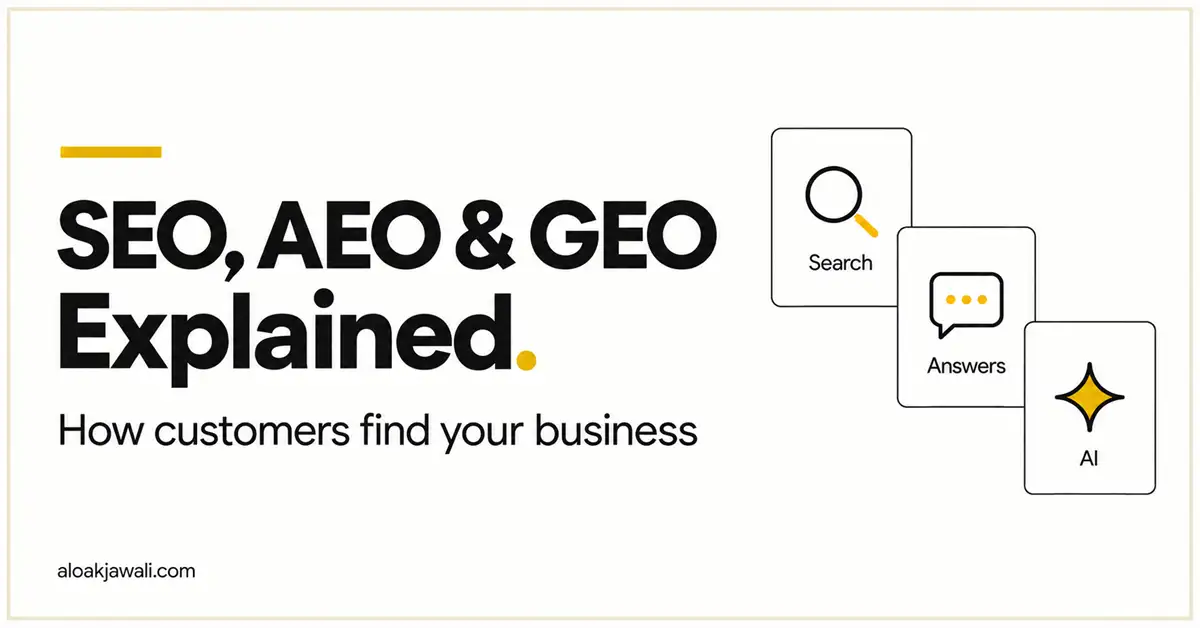
SEO AEO GEO represents three overlapping approaches to helping customers discover your business: search engine optimization, answer engine optimization, and generative engine optimization.
SEO helps people find your website through search engines. AEO focuses on answering their questions clearly. GEO focuses on visibility in answers generated by AI systems.
For a business owner, the purpose is practical: make your business easier to find, understand, evaluate, and choose.
Whether you sell directly to consumers, run a small or medium-sized enterprise, or serve other businesses, understanding these approaches can help you make better decisions about your website and content.
You do not need three disconnected marketing strategies. You need a useful website, reliable information, and content that addresses the questions customers ask before buying.
What is SEO?
Search engine optimization, or SEO, is the practice of improving your website so search engines can understand its content and people can find it through relevant unpaid search results.
Suppose you own a commercial cleaning company in Chicago. A potential customer searches for “office cleaning services in Chicago.” SEO helps your relevant service page compete for visibility when that search happens.
The work can include improving service descriptions, organizing your website, fixing technical problems, creating useful content, and earning relevant links from other websites.
A good page should explain what you offer, who it is for, where you operate, and what the visitor should do next.
Google’s SEO Starter Guide explains that SEO helps search engines understand content while helping users decide whether to visit a website.
For business owners, that makes SEO both a discovery task and a communication task. Getting a visitor to your website is valuable only when the page helps that person move forward.
What is AEO?
Answer engine optimization, or AEO, is the practice of making information clear and useful for experiences that answer questions directly.
Those experiences can include featured snippets, answers surfaced through People Also Ask, and some conversational or voice interfaces.
Imagine someone asks, “What does a commercial cleaning contract include?”
An effective answer explains the typical scope immediately, then discusses visit frequency, supplies, exclusions, and pricing factors. The reader should not have to scroll through several paragraphs of promotion to find the answer.
Useful AEO content often includes descriptive headings, straightforward explanations, comparisons, and relevant FAQs.
These formats help people read and understand the page. They do not guarantee that a search engine will select your answer.
AEO works best when the answer is complete enough to be useful and specific enough to reflect your expertise.
What is GEO?
Generative engine optimization, or GEO, describes work intended to improve how a business and its content appear in AI-generated answers.
An AI search experience may combine information from several sources to explain a topic, compare options, or help someone evaluate a purchase.
For example, a buyer might ask:
“Which commercial cleaning services should a small medical office compare, and what questions should we ask each provider?”
A useful source would explain relevant service capabilities, limitations, evaluation criteria, and supporting evidence.
GEO therefore involves more than repeating a brand name. Your information needs to be accurate, accessible, and worth referencing.
The terminology is not standardized. Some marketers use AEO and GEO interchangeably, while others distinguish direct answers from broader generated responses. Google explains that, for its own generative search experiences, this optimization remains part of SEO. Google’s generative AI optimization guide
SEO AEO GEO Comparison: What is the Difference?
| Approach | Main emphasis | Example customer question | Useful business outcome |
| SEO | Discoverable, relevant website content | “Commercial cleaning company Chicago” | Qualified visits to a service page |
| AEO | Clear answers to specific questions | “What does office cleaning include?” | Visibility while customers research |
| GEO | Useful source material for AI-generated responses | “Compare cleaning options for a small medical office” | Brand or source visibility during evaluation |
These approaches overlap. One strong service page can support all three by describing the service clearly, answering important questions, and providing evidence that helps a buyer evaluate it.

Why do B2C, SME and B2B Businesses Need This?
Different businesses need different content because their customers make different decisions.
B2C businesses sell to individual consumers. An online furniture store should help shoppers understand dimensions, materials, delivery, assembly, and returns. Product discovery matters, but so does answering the questions that prevent someone from ordering.
SMEs are small and medium-sized enterprises. An SME may sell to consumers, businesses, or both. A smaller company can start with its most important services and customer questions instead of trying to publish about every topic in its industry.
B2B businesses sell to other businesses. Their buyers may need implementation details, integration information, service agreements, procurement documents, or evidence of relevant experience. A general definition article rarely answers everything a purchasing team needs.
Consider these illustrative examples:
| Business | Content that helps buyers | Next action |
| Online furniture retailer | Product specifications and room-size guidance | View a suitable product |
| Local HVAC company | Service-area pages and repair-versus-replacement explanations | Request an appointment |
| B2B software company | Integration documentation and implementation comparisons | Request a demonstration |
| Commercial supplier | Product compatibility, availability, and purchasing requirements | Request a quote |
The shared goal is to connect a real customer need with a useful answer and a relevant offer.
7 Long-Term Benefits of SEO, AEO, and GEO
1. Reach Customers Who Are Already Looking for Help
A person searching for a specific service or asking a detailed product question is expressing a need.
Your content can meet that need at the right moment. A page about emergency repair availability, for example, serves a different purpose from a general educational article.
Prioritize topics that connect naturally to what your business actually provides.
2. Build a Library of Useful Business Assets
A strong buying guide, service explanation, or comparison can remain useful after its publication date.
Over time, related pages can form a resource customers return to when making decisions. Your sales and support teams can also share those pages.
The lasting value comes from maintaining accurate information and improving pages as customer needs change.
3. Give Buyers More Reasons to Trust You
Specific information is more persuasive than vague claims.
Explain how a service works. Show relevant qualifications. Publish authentic examples with appropriate permission. Describe the limits of a product as clearly as its strengths.
This helps buyers judge whether your business fits their needs before they contact you.
4. Support Discovery Across Different Search Experiences
Some customers prefer browsing websites. Others want a quick answer or an AI-assisted comparison.
A clear, accessible website gives your information a stronger foundation across these experiences. However, each platform has its own systems, and visibility in one does not guarantee visibility in another.
5. Reduce Uncertainty Before a Purchase
Customers often hesitate because they cannot find basic information.
What is included? Who is the service for? What affects the price? How does onboarding work? What happens after purchase?
Answering these questions can help visitors take a more informed next step and help your team have more productive conversations.
6. Diversify Customer Acquisition
Organic visibility can become another source of discovery alongside advertising, referrals, partnerships, and social media.
That does not make SEO free. Content, maintenance, and specialist work require resources. It can, however, help a business avoid relying entirely on one acquisition channel.
7. Learn What Customers Need Next
Search queries, inquiries, and recurring sales questions can reveal gaps in your content.
If customers repeatedly ask whether a product works with a particular system, that may justify a compatibility page. If buyers misunderstand a service package, the explanation may need improvement.
This feedback makes your content more useful over time.
How Long Do SEO, AEO, and GEO Take to Work?
There is no reliable deadline that applies to every business.
Google says some website changes can affect search results within hours, while others may take several months. It also notes that not every change produces a noticeable improvement. Google’s guidance on timing
For planning purposes, use milestones you can control:
| Planning period | Practical priority |
| First 30 days | Establish a baseline, check accessibility, and improve important pages |
| Days 31–60 | Publish useful answers and add credible supporting evidence |
| Days 61–90 | Review early data and refine weak or incomplete content |
| Following quarters | Evaluate qualified leads, sales contribution, and sustained visibility |
This is a suggested work schedule, not a forecast of ranking or revenue.
There is also no universal time-to-citation for AEO or GEO. An AI system may reference a page during one observation and use different sources later.
Long-term benefits depend on continued relevance. A useful page can keep contributing, but outdated information, stronger competitors, or changing customer expectations can reduce its value.
A Practical 90-Day Starting Plan
Days 1–30: Choose the Business Priority
Start with one important product, service, or customer segment.
List the questions customers ask before buying. Choose the pages most directly connected to revenue, and check whether visitors can understand the offer and complete the intended action.
For a U.S. audience, use appropriate terminology, accurate service areas, and U.S. pricing or delivery information when relevant. Do not imply a local presence you do not have.
Days 31–60: Improve the Answers and Evidence
Strengthen those pages with information that helps customers decide.
A service business might explain its process and exclusions. A retailer might add original product photographs and detailed specifications. A B2B company might publish implementation guidance or a documented customer example.
Keep important information available as readable page text. Images can support the explanation, but they should not contain the only copy of an essential answer.
Days 61–90: Measure and Refine
Check whether your pages are being discovered and whether visitors take useful actions.
Review real inquiries as well as analytics. More visits with fewer qualified inquiries may indicate that the content attracts the wrong audience or sets the wrong expectations.
Expand into related topics when they help the same audience make progress.
Three Expert Perspectives Business Owners Can Apply
John Mueller: Make the Content Useful
“Focus on your visitors and provide them with unique, satisfying content.”
— John Mueller, Google Search Relations, Google Search Central
For your business, this means adding information customers cannot get from another generic article: practical experience, original examples, and clear explanations.
Seth Godin: Start With Something That Matters
“Marketing is making a product or service that matters.”
— Seth Godin, author and marketer, Seth’s Blog
Visibility is most useful when the business behind the content delivers something customers value.
Jeff Bezos: Keep the Customer at the Center
“We will continue to focus relentlessly on our customers.”
— Jeff Bezos, Amazon founder, 1997 shareholder letter
Your content priorities should reflect what customers need to understand, compare, and buy.
How to Measure Business Results
Evaluate visibility and business outcomes together.
For a B2C company, useful outcomes may include purchases, product inquiries, or appointment bookings. For a B2B company, they may include qualified leads, demonstrations, or sales opportunities.
Use Google Search Console to understand search performance, and filter by the United States when assessing your U.S. audience.
For AI visibility, Google now provides a Generative AI performance report covering impressions from AI Overviews and AI Mode. Its documentation states that these insights rolled out worldwide by August 31, 2026. A property may still lack a visible report if it has insufficient relevant impressions. Google’s report documentation
An impression means visibility, not a sale. Connect reporting with website conversions and lead quality.
You can also periodically check a consistent set of customer questions across relevant search experiences. Record the date, wording, location settings, and cited sources. Treat those checks as samples rather than a complete measure of market visibility.
FAQs
1. Is AI SEO Called GEO?
GEO is one term marketers use for improving visibility in AI-generated answers. Other terms include AEO and AI search optimization. Their meanings overlap, so evaluate the actual work being proposed rather than choosing a provider based on an acronym.
2. Will AEO or GEO Replace SEO?
They should not be treated as replacements for the fundamentals of SEO. Google’s AI search experiences still depend on its search systems. A useful website, accessible content, and relevant information remain important foundations. Google’s explanation
3. What Are the Four Types of SEO?
A common practical grouping is on-page SEO, technical SEO, off-page SEO, and local SEO. These cover page content, website accessibility and operation, external signals such as relevant links, and visibility for location-based searches. This is a common teaching framework, not a universal official classification.
4. Is Google Ads Part of SEO?
No. Google Ads is paid advertising, while SEO focuses on unpaid search visibility. Businesses can use both, but buying Google Ads does not improve organic rankings.
5. Does a Small Business Need Three Separate Campaigns?
Usually, a small business can start with one coordinated plan. Improve essential pages, answer purchase-related questions, and make business information accurate. Then decide whether additional work is justified by customer behavior, available resources, and measurable business opportunities.
6. How Much Do SEO, AEO, and GEO Cost?
There is no standard price that fits every business. Costs depend on the website, competition, content needs, technical problems, and scope of work. Ask for specific deliverables, priorities, reporting methods, and ownership terms so you can compare proposals meaningfully.
7. Can One Page Rank in Search and Appear in AI Answers?
Yes, a page may be eligible for both. For Google, it must meet the relevant indexing and display requirements, including eligibility for a search snippet and inclusion in its generative AI features. Eligibility does not guarantee selection.
8. Will Adding FAQ Schema Make My Business Appear in Google Answers?
No. FAQ markup does not guarantee selection for an answer or AI response. Google stopped displaying FAQ rich results beginning May 7, 2026. Keep FAQs because they help customers understand your content, rather than expecting that former search appearance.
Make your business easier to find — and easier to choose
Your customers have questions. Your website should help them find clear answers and understand why your business may be the right fit.
Start with your most important offer, explain it well, and build useful content around the decisions customers need to make.
Explore Aloak Jawali website to learn more about SEO, AI and answer-focused visibility for your business.